
Olivia Wilde · Actor and director
Olivia Wilde's Eyes: Green, Blue or Gray?
Green to gray-green best fits the evidence; conflicting editorial labels show the limits of naming a low-saturation iris from photographs.
- Evidence status
- First-person + differing profiles
Last reviewed September 2, 2026
By Iris Analyzer Editorial Team
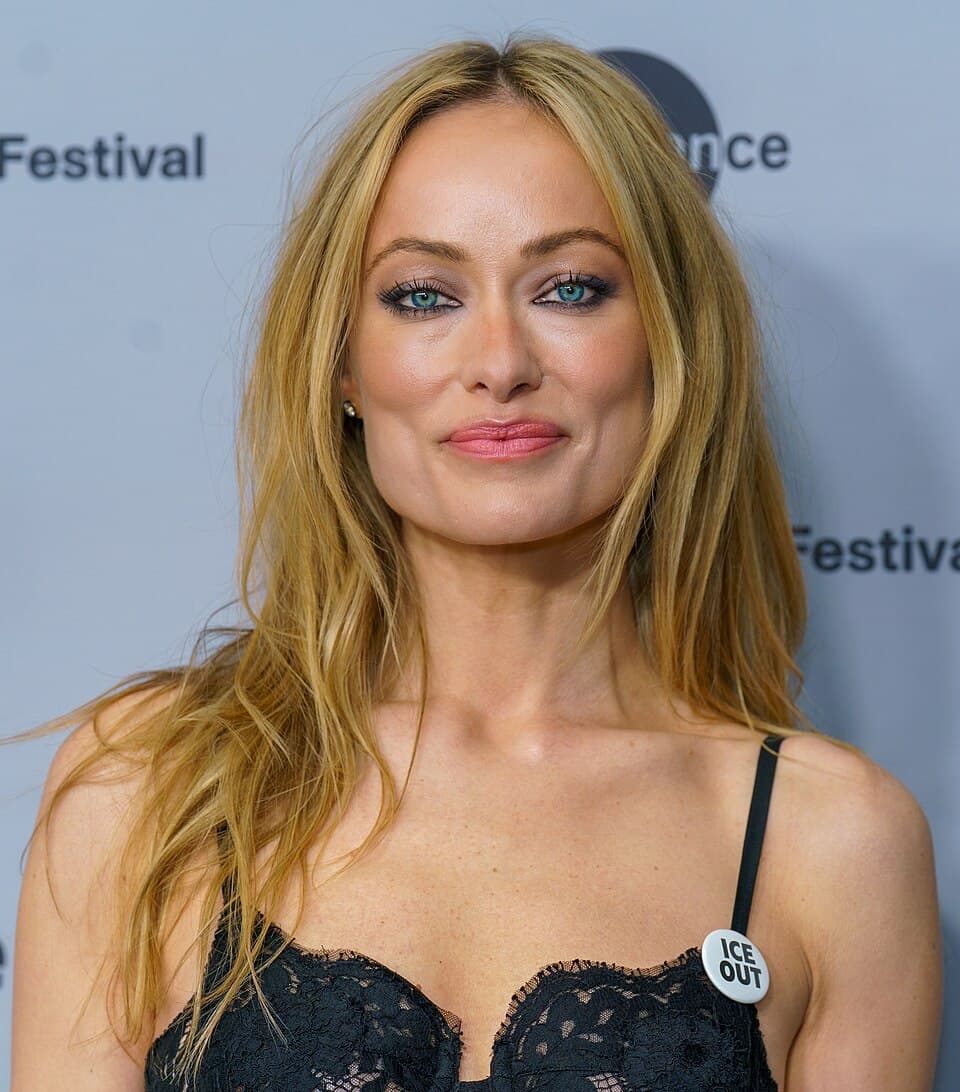
Olivia Wilde, whose eyes are best supported as green to gray-green despite varying editorial labels.
Olivia Wilde at the 2026 Sundance Film Festival (cropped) · Colleen Sturtevant · CC BY 4.0 · Commons crop; Wikimedia resize
.jpg)
What color are Olivia Wilde's eyes?
Green to gray-green is the most defensible answer. In a beauty interview, Wilde says that purple makeup is useful for bringing out green in the eye and explains that she uses it for herself. GQ describes her eyes as sharply green. Nylon twice uses mixed wording—bright gray-green and green-gray—during an in-person cover story. Those sources converge on green while acknowledging a muted or gray component.
Vogue complicates the record by calling her eyes blue in a beauty feature. That disagreement should not be erased, because it demonstrates why celebrity eye-color claims require calibrated language. Everyday observers draw boundaries between blue, gray and green differently, particularly for a light iris with low saturation. The evidence does not support a single laboratory shade; it supports green to gray-green as the best overall editorial summary.
Why do reputable sources call them different colors?
Color categories are names imposed on a continuous visual range. Cleveland Clinic notes that experts do not all divide eye colors in exactly the same way and that each iris contains a unique mixture of color and pattern. A low-saturation iris can sit near the ordinary-language boundary between gray, green and blue. One writer may emphasize its dominant green impression while another responds to a cooler appearance under different light.
The publication record matches that problem unusually well. GQ’s “sharply green” is decisive in one encounter. Nylon’s gray-green phrasing records a mixed impression. Vogue’s blue label captures a cooler reading. These descriptions need not mean the iris pigment changed between interviews. They show that unstandardized observers, cameras and environments can place the same appearance on different sides of a fuzzy naming boundary.
What Wilde’s own makeup comment establishes
Wilde’s first-person comment deserves particular weight because she discusses a technique she uses to make green in her eyes stand out. Purple and green create a strong visual contrast, so a purple shadow or liner can make an existing green component feel more prominent. Her statement supports green as part of the correct description and explains a recurring styling choice. It is more reliable than a fan assigning a category from one crop.
The comment has limits. Wilde does not provide a clinical classification, say that both irises have been separately graded or diagnose a pigment pattern. “Bring out any green” is ordinary beauty language, not a medical observation. It should be combined with the GQ and Nylon descriptions rather than stretched into proof of a narrowly named subtype. First-person evidence improves the answer without making it more precise than the words allow.
Why green-gray eyes can look blue on camera
White balance, exposure and surrounding colors all influence a light iris. Cool illumination can emphasize blue-gray reflections; warm light can reduce them and allow yellow-green elements to become more noticeable. Pupil size changes the amount of visible iris, while eyeliner, clothing and background colors alter contrast. A phone screen, magazine reproduction or compressed video then adds another set of color decisions between the subject and the viewer.
Peer-reviewed iris-grading work relies on controlled illumination, fixed camera settings and reference photographs to make comparisons reproducible. Editorial portraits and beauty videos are designed for expression and style, not measurement. Vogue’s blue wording therefore should be preserved as a genuine description of an appearance, but it should not automatically outweigh the first-person green context and two publications that explicitly report green or gray-green.
Does Olivia Wilde have heterochromia or colored contacts?
The reviewed evidence does not establish heterochromia. The reputable profiles describe her eyes collectively as green, gray-green or blue; they do not document one iris as a different color from the other or identify a sectoral color difference. Online lists often repeat the heterochromia label without a clinical or direct source. This page does not promote that repetition into fact merely because the claim is popular.
No reliable source reviewed here establishes routine cosmetic colored contacts either. A color difference between two photographs is not sufficient evidence of lenses, because lighting and processing already explain substantial shifts in light irises. The accurate formulation is narrow: green to gray-green is best supported, publication labels vary, and neither heterochromia nor contacts has been verified by the evidence used for this profile.
How to state the verdict responsibly
A source-checked answer should rank the evidence rather than force artificial unanimity. Wilde’s own beauty comment identifies green in her eyes. GQ agrees with green, while Nylon offers the more nuanced gray-green label. Vogue’s blue description is retained as a credible minority reading and as a warning against false certainty. This hierarchy supports “green to gray-green” more strongly than a flat blue or a sensational heterochromia claim.
The boundary matters beyond one celebrity. A photograph can document appearance under particular conditions, but it cannot reveal an exact lifelong color free from lighting and camera influence. Readers comparing their own eyes should use unfiltered, evenly lit images and accept mixed wording when appropriate. A visual resemblance to Wilde is descriptive only; it does not prove a medical condition, ancestry, genetic relationship or identity.
Questions, answered carefully
Sources and what they support
Each source is attached to a specific claim. The portrait is licensed editorial imagery and is not treated as diagnostic evidence.
01 · beautyheaven
Olivia Wilde interview
First-person contextSource checked September 2, 2026
Wilde discusses the green appearance of her own eyes.
Open source02 · GQ Magazine
Olivia Wilde
Editorial profileSource checked September 2, 2026
GQ describes Wilde's eyes as green.
Open source03 · Nylon
Olivia Wilde Cover Story
Editorial profileSource checked September 2, 2026
Nylon uses the blended description gray-green.
Open source04 · Vogue
Olivia Wilde Beauty Secrets
First-person contextSource checked September 2, 2026
The Vogue beauty feature uses blue wording and documents Wilde’s eye styling, adding context to the published label disagreement.
Open source05 · Cleveland Clinic
Eye Colors
Eye-health referenceSource checked September 2, 2026
Eye-color labels describe broad categories rather than universally agreed standardized shades. Hazel can combine visible brown, gold and green tones.
Open source06 · Eye (Nature) via PubMed Central
A novel eye color classification scale for epidemiological studies
Scientific referencePublished December 13, 2013Source checked September 2, 2026
Reproducible photographic iris grading depends on standardized illumination, camera settings and processing.
Open source