
Aishwarya Rai Bachchan · Actor and former Miss World
Aishwarya Rai Bachchan's Eyes: Green, Blue, or Gray?
The source trail supports naturally light green-to-green-gray eyes whose recorded color shifts with light, styling, and editorial vocabulary.
- Evidence status
- Published descriptions vary
Last reviewed September 2, 2026
By Iris Analyzer Editorial Team
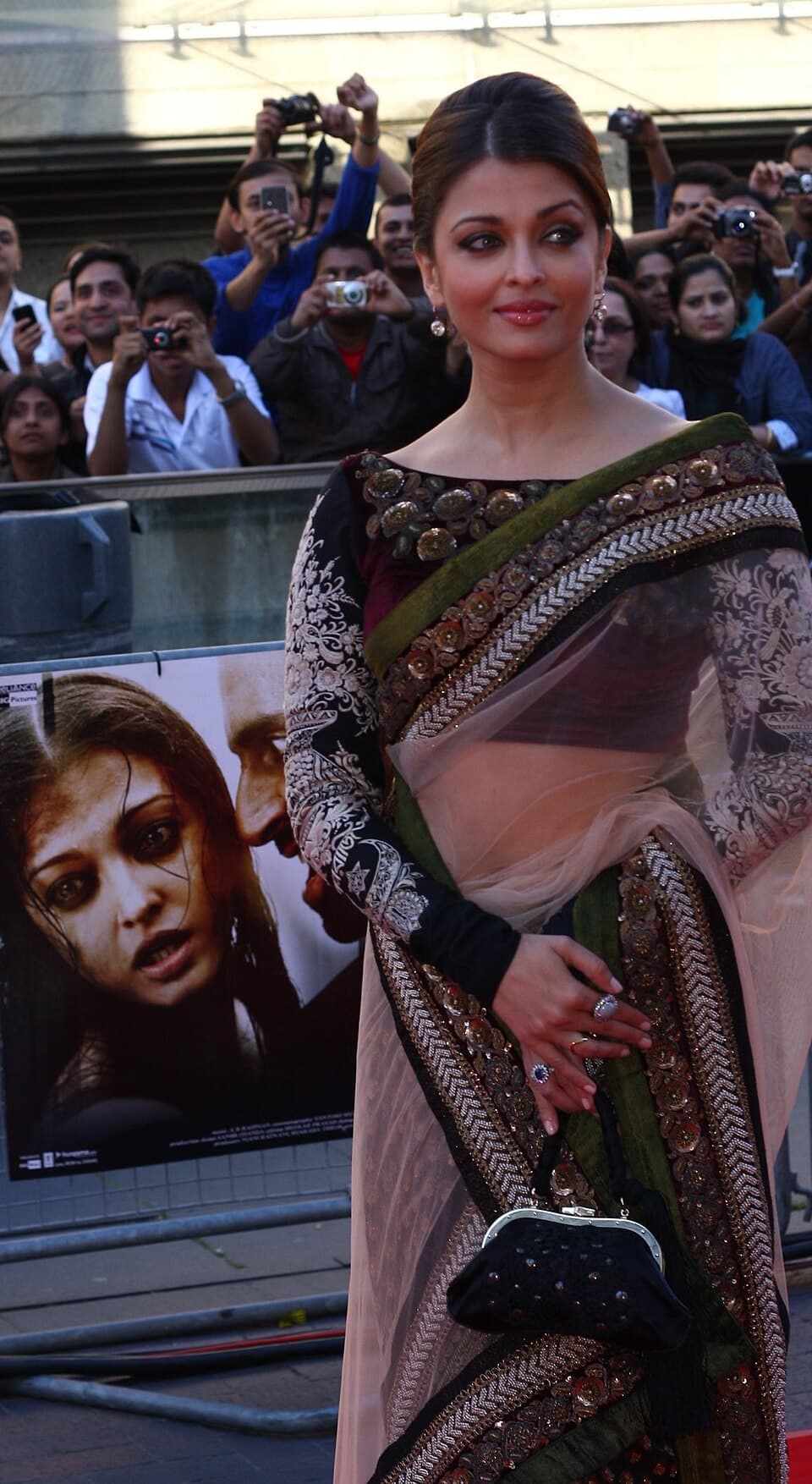
Aishwarya Rai Bachchan. Published descriptions—not color sampling from this styled event portrait—support the green-to-blue-green range.
Aishwarya Bachchan · Mark B. · CC BY 2.0 · Wikimedia resize

What color are Aishwarya Rai Bachchan's eyes?
The most careful answer is green to green-gray, often appearing blue-green. eSakal and Live Hindustan report Rai Bachchan’s own explanation that her eyes are naturally green, with a sea-like green-gray quality, and that sunlight or artificial light can make them look more purely green or blue. That account explains why a single fixed label repeatedly fails across interviews, films, and event photography.
Major editorial descriptions demonstrate the range. The Star calls the eyes blue-green, while NDTV uses “blue-eyed.” Those labels are observations made under particular editorial and photographic conditions, not contradictions that require choosing a winner. The first-person description should anchor the answer; blue-green and blue remain useful descriptions of how the same light irises can register in certain captures.
Why green, blue, and gray can all appear in descriptions
Eye-color categories are broad names applied to a complex visual surface. A lightly pigmented iris can contain several tones and strong radial texture. Its recorded appearance depends on the spectrum and direction of the light, the size of the pupil, reflections from the environment, and the camera’s white balance and exposure. Green-gray can therefore lean blue in cool illumination and greener in warm or neutral daylight without biological pigment changing from moment to moment.
Cleveland Clinic explains that clothing, makeup, and environmental light can bring out blue or green tones as an optical effect. That guidance closely matches Rai Bachchan’s reported account of color shifting with illumination. It also cautions against treating a cropped red-carpet photograph as a laboratory measurement. A descriptive range—green, green-gray, blue-green—better reflects the source evidence than a claim that every observer must perceive the same single swatch.
- Reported natural description: green to sea-like green-gray
- Common editorial description: blue-green
- Some editorial shorthand: blue
- Unsupported conclusion: that ordinary photo-to-photo variation means the irises physically keep changing color
How makeup and screen styling change the impression
Vogue India documents Rai Bachchan’s willingness to experiment with conspicuous Cannes makeup, including an electric-blue eye treatment. Blue liner or shadow beside a green-gray iris can emphasize cool tones; earth colors may bring forward green or warmer flecks. Studio lighting, costume colors, and post-production grading can then amplify the result. Such images are evidence of a designed look, not a neutral test of natural pigment.
Live Hindustan also recounts her story about wearing brown contacts for a film role. That distinction matters: a brown-eyed screen appearance need not disprove naturally light eyes, just as a blue-styled Cannes photograph does not prove that “blue” is the only correct natural label. The source-based method separates what she reports as natural from a specific production or beauty choice and avoids guessing about contacts when no source documents them.
Does Aishwarya Rai Bachchan have heterochromia?
The sources reviewed here do not support that claim. Heterochromia describes a meaningful color difference between the two irises or within a localized part of one iris. Rai Bachchan and the cited publications discuss her eyes together, using green, green-gray, blue-green, or blue for the pair. Variation in how both eyes photograph under different conditions is not evidence that the two irises have different underlying colors.
Online lists sometimes group any unusual, light, multitone, or camera-variable eye appearance under heterochromia, but those concepts are not interchangeable. Green-gray eyes can look multicolored without one eye differing from the other. Without a direct statement, clinical source, or clear published description of asymmetric pigmentation, this article does not attach a heterochromia label. The distinctive feature is the light, context-sensitive color range—not a sourced mismatch between sides.
What photographs can—and cannot—prove
A photograph can document that Rai Bachchan’s eyes looked blue-green, gray-green, blue, or brown-styled in that frame. It cannot by itself determine natural pigment, contact-lens use, or whether retouching occurred. Small iris regions are especially vulnerable to reflections, eyelashes, soft focus, compression, and skin-tone-oriented color correction. Sampling pixels may accurately describe the file while misrepresenting the iris hidden beneath its lighting conditions.
The stronger approach combines first-person reporting with repeated reputable observations and openly explains their limits. Her reported green-to-green-gray description anchors the natural-color answer. The Star and NDTV show how editors perceive the public images; Vogue documents at least one deliberately blue beauty treatment. These sources are complementary when each is used for the claim it can actually support rather than treated as competing laboratory readings.
The claim-check verdict and a better comparison method
The verdict is that green to green-gray is the strongest reported natural description, while blue-green is a well-supported appearance label and blue is common editorial shorthand. Lighting and styling explain much of the variation. Brown contacts have been reported for a role. The evidence does not support different-colored irises, constant contact use, or an assertion that the natural eye color literally changes between events.
If your own light eyes seem to shift similarly, photograph them together under neutral indirect daylight with filters disabled, then repeat under another known light source. Record dominant color, central rings, and localized sectors separately. Do not infer a celebrity’s biology from a resemblance, and seek eye care for a genuinely new color change rather than attributing it to normal camera variation. The useful lesson from this profile is vocabulary and source discipline, not a diagnostic comparison.
Questions, answered carefully
Sources and what they support
Each source is attached to a specific claim. The portrait is licensed editorial imagery and is not treated as diagnostic evidence.
01 · eSakal
Aishwarya Rai Bachchan reveals her eye colour
First-person contextSource checked September 2, 2026
The article reports Rai Bachchan describing her eyes as more green than blue.
Open source02 · Live Hindustan
Aishwarya Rai's real eye colour
Editorial profileSource checked September 2, 2026
The feature reports green as the broad answer while acknowledging the familiar blue-green appearance.
Open source03 · The Star
Aishwarya is picture perfect
Editorial profilePublished June 24, 2013Source checked September 2, 2026
The profile describes Rai Bachchan’s eyes as blue-green.
Open source04 · NDTV
Aishwarya Rai Bachchan: World's envy, India's pride
Editorial profileSource checked September 2, 2026
NDTV uses blue-eyed wording, documenting the label variation.
Open source05 · Cleveland Clinic
Can Eye Color Change?
Eye-health referenceSource checked September 2, 2026
Apparent eye color can vary with lighting and surroundings, while a new persistent change warrants professional evaluation.
Open source06 · Vogue India
Aishwarya Rai Bachchan on cinema, work and Cannes
Editorial profileSource checked September 2, 2026
The editorial profile provides context for how Rai Bachchan is photographed and styled in public appearances.
Open source