
Eye Color Chart: Every Color From Brown to Gray
All the human eye colors, ranked from most common to rarest.
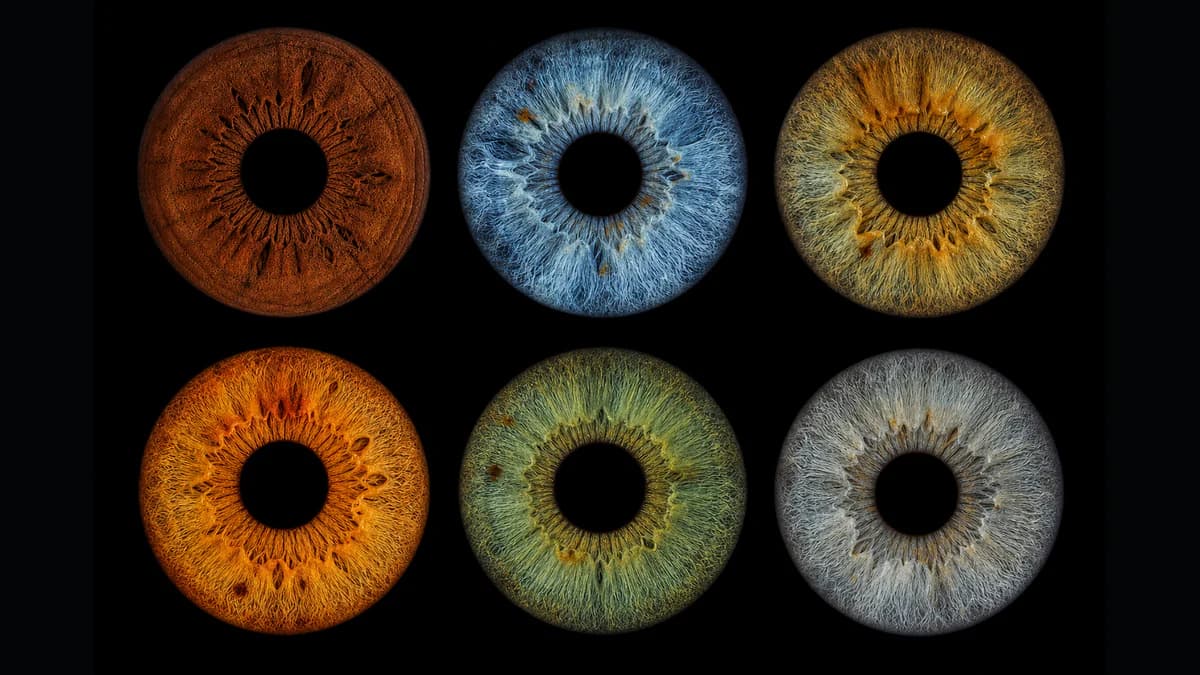
The full spectrum
Human eye color runs on a single underlying dial — melanin — but the results span a wide spectrum. From most common to rarest:
- Brown (70–80% worldwide): highest melanin, from honey to near-black
- Blue (8–10%): almost no melanin; the color is scattered light
- Hazel (~5%): a true mix — green and brown/amber in zones
- Amber (<5%): solid golden-copper, often called wolf eyes
- Green (~2%): the rarest of the everyday colors
- Gray (<1%): blue’s rarer cousin, denser iris fibers
- Heterochromia (<<1%): two different colors on one person
- Common · 70–80% of people worldwideThe world’s most common eye color — and one of its most varied.
- Uncommon · 8–10% of people worldwideNot blue pigment at all — structural light scattering.
- Rare · ~5% of people worldwideTwo colors in one iris — and never the same twice.
- Rare · Under 5% worldwide, and much rarer in some regionsA solid golden-copper iris — often called wolf eyes.
- Rare · ~2% of people worldwideThe rarest of the common eye colors.
- Very rare · Under 1% worldwideOne of the rarest eye colors — blue’s mysterious cousin.
- Rare · No reliable global statistics — uncommon, often unnoticedA ring of a different color around your pupil.
- Exceptionally rare · Complete heterochromia: very rare (well under 1%)Two different eye colors on one person.
Why charts alone mislead
A chart shows categories, but almost no real iris is a single category. Most "brown" eyes carry amber rays; most "green" eyes carry gold or gray; hazel is a mix by definition. Lighting shifts things further — the same eye can look different at noon and under warm indoor light.
That’s why comparing your eye to swatches in a mirror so often ends in an argument. The honest answer is a percentage mix, not a single word.
Measure instead of guessing
A close-up photo analyzed pixel-by-pixel gives you the actual ratio — for example 42% green, 31% amber, 18% brown — then groups related shades to estimate the global rarity of the largest broad color family. It runs in your browser, and the photo never leaves your device.
Eye color percentages worldwide
Estimates vary by study and by region, but the global picture is consistent: brown dominates everywhere, and every other color is a minority. As a rough share of the world's population:
- Brown: the clear global majority — estimates run from 55% to nearly 80%
- Blue: roughly 8–10%, concentrated in Northern and Eastern Europe
- Hazel: about 5%
- Amber: about 3%
- Green: about 2% — the rarest of the everyday categories
- Gray: around 1%, and frequently miscounted as blue
The genetics behind the chart
Two genes do most of the work. OCA2 drives how much melanin your iris produces, and its neighbor HERC2 acts as the dimmer switch that turns OCA2 up or down. High melanin reads as brown; very little reads as blue or gray; the amounts in between produce green, hazel, and amber.
But at least 16 genes influence the final result, which is why eye color doesn't follow the simple dominant/recessive chart from biology class. Siblings can land on different colors, and two brown-eyed parents can have a blue-eyed child if both quietly carry low-melanin variants.
Stop guessing — measure it
Photo-based color percentages, rarity score, and a shareable Iris Card in 60 seconds. Private: your photo never leaves your device.
Analyze My Eye Color FreeFrequently asked questions
What is the rarest eye color?
Among the everyday colors, green is rarest at roughly 2% of people worldwide. True gray and true amber are comparably rare or rarer, and complete heterochromia (two entirely different-colored eyes) is the rarest trait of all.
What is the most common eye color?
Brown, by a wide margin — roughly 70–80% of the world’s population. The exact shade and the hidden secondary colors vary enormously from person to person.
Can my eye color change?
Adult iris pigment is stable. What changes is perception: lighting, pupil size, clothing, and surroundings shift which tones dominate — especially in mixed-color eyes like hazel.
Where do hazel and amber sit on an eye color chart?
Between brown and green. Hazel is a mix of brown/gold and green arranged in zones, while amber is a single uniform golden-copper tone. Charts that only list "brown, blue, green" are lumping both into brown — which is why so many hazel and amber people misidentify their color.
How accurate are eye color percentage charts?
The rankings are reliable; the exact figures are estimates. Studies differ in how they classify borderline colors like blue-gray or green-hazel, so published numbers move a few points. What never changes: brown is the majority, and green, amber, and gray are rare.