
How Rare Is My Eye Color? Prevalence, Ranked
Your category is common knowledge. Your mix is not.
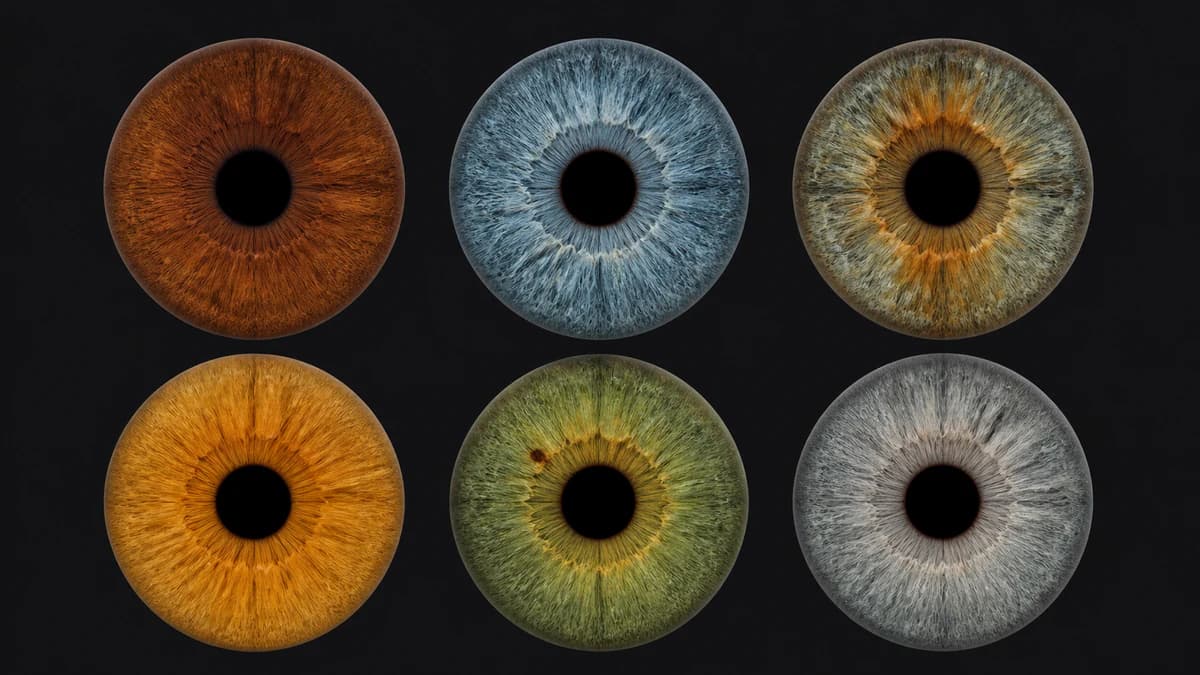
Rarity by category
The commonly cited global prevalence figures:
- Brown: 70–80% — the global default
- Blue: 8–10% — concentrated in Northern Europe
- Hazel: ~5% — the mixed category
- Amber: <5% — true solid amber is much rarer than the label
- Green: ~2% — rarest everyday color
- Gray: <1% — often miscounted as blue
- Complete heterochromia: far below 1%
- Common · 70–80% of people worldwideThe world’s most common eye color — and one of its most varied.
- Uncommon · 8–10% of people worldwideNot blue pigment at all — structural light scattering.
- Rare · ~5% of people worldwideTwo colors in one iris — and never the same twice.
- Rare · Under 5% worldwide, and much rarer in some regionsA solid golden-copper iris — often called wolf eyes.
- Rare · ~2% of people worldwideThe rarest of the common eye colors.
- Very rare · Under 1% worldwideOne of the rarest eye colors — blue’s mysterious cousin.
- Rare · No reliable global statistics — uncommon, often unnoticedA ring of a different color around your pupil.
- Exceptionally rare · Complete heterochromia: very rare (well under 1%)Two different eye colors on one person.
Why analyzer shades are grouped into broad families
An iris contains many visible shades, but population studies report broad whole-eye categories — not independent pixel colors. The analyzer therefore combines related shades first: light blue, deep blue, and teal count together as blue; olive contributes to hazel; violet contributes to gray. The largest combined family sets the baseline.
Getting your number
An iris analysis measures all visible color percentages, groups them into those broad families, and uses the largest family's approximate global prevalence to derive a color rarity score from 0 to 99. Raw shade bands are not treated as separate rare events or multiplied together. Independently detected complete heterochromia is the only additional numeric signal. If several color families have close measured shares, the app does not show a numeric rarity estimate. A rough color-family score, not a ranking of your unique iris. Lighting and mixed colors can affect it.
The world map of eye color
Global rarity and local rarity are different questions. Brown is the majority worldwide and near-universal across Africa, Asia, and South America. Blue eyes are a minority globally (roughly 8–10%) yet the majority in Estonia, Finland, and much of the Baltic. Ireland and Scotland are the world's green-eye hotspots, with rates several times the global 2%.
So "how rare are my eyes?" has two honest answers: the approximate global prevalence of your broad color family, and how often anyone around you shares it. Green eyes in Dublin are a conversation; green eyes in Seoul are an event.
Visual uniqueness beyond the score
Two people can both check the "green" box and have very different eyes. A dark limbal ring, gold flecks, a contrasting ring around the pupil (central heterochromia), or an unusual mixture — say, olive green shot through with gray — can make an iris visually distinctive. Those are descriptive details, not separate population-prevalence data.
For that reason, those details do not add rarity points. Gold content, palette diversity, secondary bands, and central heterochromia stay in the description; the score remains anchored to the dominant broad family. This avoids inflating every multitone iris.
Stop guessing — measure it
Photo-based color percentages, rarity score, and a shareable Iris Card in 60 seconds. Private: your photo never leaves your device.
Analyze My Eye Color FreeFrequently asked questions
What are the top three rarest eye colors?
Excluding heterochromia: gray (under 1%), green (~2%), and true amber. Complete heterochromia — two entirely different-colored eyes — is rarer than any single color.
Are violet or red eyes real?
Genuine violet appearance is essentially limited to severe albinism, where light reflects off blood vessels through an almost pigment-free iris. It is vanishingly rare and usually accompanies significant light sensitivity.
How is the color rarity score calculated?
The analyzer first adds all measured shades into broad whole-eye families, then selects the largest family and maps its approximate global prevalence to a derived color rarity score from 0 to 99. If several color families have close measured shares, the app does not show a numeric rarity estimate. It does not multiply shade percentages or boost the score for gold, palette diversity, secondary colors, or central heterochromia. Complete heterochromia, detected by comparing two irises, is the only additional numeric signal. The result is an estimate, not a census. A rough color-family score, not a ranking of your unique iris. Lighting and mixed colors can affect it.
Are black eyes real?
True black irises don't exist — eyes that look black are very dark brown, with melanin dense enough that the iris and pupil blur together in normal light. A bright photo or a pixel analysis will always find the brown.
Where are gray eyes most common?
Northern and Eastern Europe — the Baltic region especially. Even there they're a small minority, and globally they hover around 1%, which makes gray one of the rarest natural eye colors.