
Cate Blanchett · Actor and producer
Cate Blanchett's Eyes: Blue, Source-Checked
Independent observers describe pale, light, diamond or slate-blue eyes, while a makeup artist who worked with Blanchett explicitly calls them blue.
- Evidence status
- Multiple in-person profiles + makeup professional
Last reviewed September 2, 2026
By Iris Analyzer Editorial Team
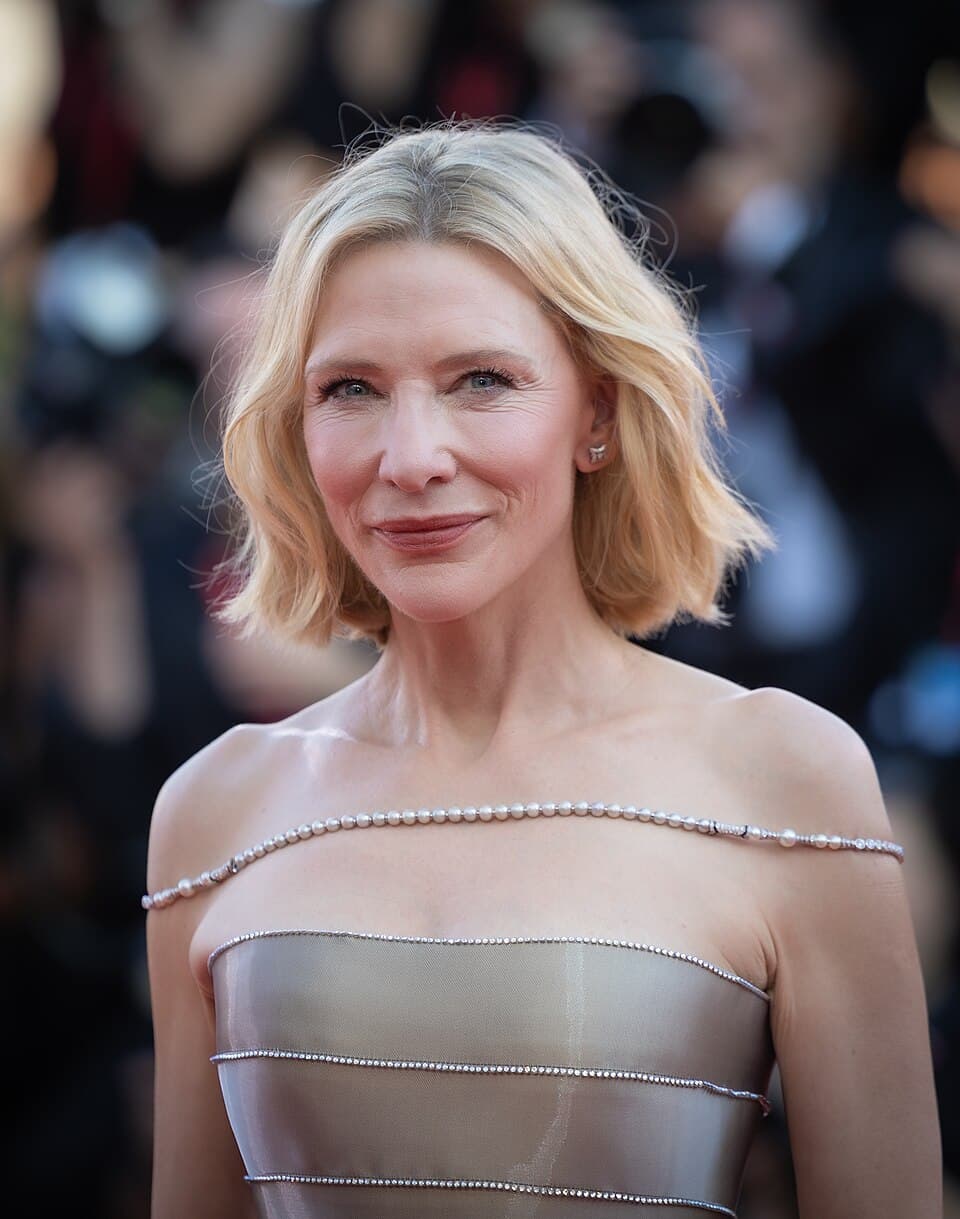
Cate Blanchett, whose eyes are repeatedly described as blue by in-person reporters and a makeup artist who worked with her.
Cate Blanchett-63298 · Harald Krichel · CC BY-SA 4.0 · Wikimedia resize

What color are Cate Blanchett's natural eyes?
Blue is the strongest source-backed answer. Vogue’s Adam Green met Blanchett in London and described her unadorned face, including almond-shaped, diamond-blue eyes. The Guardian’s Howard Feinstein met her in Australia and later on the set of Elizabeth, independently calling them the palest blue. Condé Nast Traveler’s Dorinda Elliott observed Blanchett at an early-morning hair and makeup call in Sydney and wrote of penetrating light-blue eyes. The settings and adjectives differ, but the broad color does not.
These reports are more useful than trying to label the irises from one publicity portrait. They come from journalists who were physically present and describe Blanchett across ordinary conversation, a dressing room and a working film set. Vanity Fair’s archival profile adds slate-blue to the descriptive record. Pale, diamond, light and slate are not four competing biological colors; they are writers’ attempts to convey brightness, undertone and impact. The defensible family-level conclusion is blue without inventing a permanent exact shade.
Why the in-person descriptions matter
Vogue’s observation is especially helpful because it explicitly places the description on an unadorned face with Blanchett’s hair pulled back. That does not create laboratory conditions, but it reduces the chance that a dramatic eye look supplied the basic blue label. The Guardian offers temporal separation: Feinstein first met Blanchett during an Australian winter, then encountered her in costume on the Elizabeth set. His description stays within blue even while her dyed-red hair, hoop dress and production surroundings radically change the frame around her face.
Condé Nast Traveler supplies another independent encounter in a makeup chair, before the finished editorial presentation. The writer acknowledges being struck by the light-blue eyes while Blanchett multitasks with a script and phone. None of these journalists measured wavelength or pigment, so their wording cannot support a color code, clinical subtype or claim that her eyes never look gray. Their value comes from convergence: multiple people, publications and circumstances reach blue without relying on a shared celebrity database or selected online still.
What did Blanchett’s makeup artist confirm?
Harper’s Bazaar documented Jeanine Lobell preparing Blanchett for the 2015 Oscars. Lobell said the subtle smoky eye was intended to bring out Cate’s blue eyes, then identified rose, brown and plum powders topped with a shimmering gold-copper tint. This is strong professional context because Lobell was not guessing from a finished red-carpet image; she was the artist selecting and applying colors directly to Blanchett. Her wording agrees with the independent profiles and also explains why warm styling can make a cool iris appear more luminous.
The account does not prove that every image from the event reproduces the iris faithfully. Metallic pigment creates highlights, black mascara strengthens the outer boundary, and flash photography can lift or flatten color. It does show that a professional working at close range treated blue as the relevant natural color when designing the look. ELLE’s first-person beauty interview adds that Blanchett uses white pencil and jet-black mascara to brighten and enlarge the eye area, further demonstrating how cosmetics change presentation without supplying a different iris color.
Why can her blue eyes look pale, gray or slate?
Light irises are highly sensitive to photographic conditions. A large dark pupil leaves less visible blue tissue; a small pupil exposes more of it. Cool ambient light can emphasize gray components, warm reflected light can add a greenish or silvery cast, and a bright catchlight can create the jewel-like impression behind Vogue’s “diamond-blue” phrase. Vanity Fair’s slate-blue wording captures a muted presentation, while The Guardian’s “palest blue” emphasizes low saturation. The common noun remains blue throughout those descriptions.
Wardrobe and hair contribute simultaneous contrast. Copper or red hair can make blue look cooler, while a gray suit or blue-gray background may reduce saturation. Camera white balance, film stock, digital grading, magazine reproduction and screen settings add further movement. A responsible reference therefore records the stable family and preserves attributed shade language rather than voting among isolated pixels. The sources support blue that can read pale, light, gray-blue or slate; they do not support declaring a permanent gray or green natural color.
What about roles, colored contacts and heterochromia?
Blanchett is known for physical transformation, but the reviewed sources separate those choices from iris color. In ELLE she explains that Carol required near-daily eyebrow plucking to create a stern visual line. British Vogue records that she changed from blonde to brunette for a stage role rather than wearing a wig. The Guardian encountered her with dyed-red hair and Elizabeth costume styling. Each choice alters contrast, perceived complexion and the prominence of the eyes, yet none documents a colored contact lens or natural color change.
No reliable reviewed source reports that Blanchett routinely uses cosmetic contacts, and no source identifies a production-specific lens that should be generalized to her natural appearance. That does not prove a lens has never been used for vision, comfort or an unreviewed role; it means the broader claim is unsupported. The same boundary applies to heterochromia. Unequal shadows or reflections can make one eye look grayer in a photograph, but no credible source here reports stable left-right color difference, and images alone should not be used to diagnose one.
How the Cate Blanchett eye-color claim was checked
Verification began with explicit person-specific language. Vogue, The Guardian and Condé Nast Traveler each describe blue during reported encounters, while Vanity Fair supplies the compatible slate-blue formulation. Harper’s Bazaar then provides direct makeup-professional corroboration from Jeanine Lobell. ELLE and British Vogue are used for their proper purpose: they document how Blanchett and her teams manipulate liner, lashes, eyebrows and hair for performance and public appearances. They are not stretched into evidence for contacts or an exact iris subtype.
The resulting answer is clear but bounded. Cate Blanchett’s natural eyes are blue. They may appear very pale, gray-blue, slate, brighter or more jewel-like as pupil size, makeup, surrounding color, capture and grading change. The reviewed record does not establish gray as a better baseline, nor does it substantiate heterochromia or habitual colored lenses. Stating those limits prevents evocative editorial adjectives and transformative roles from being mistaken for contradictions in the underlying source evidence.
Questions, answered carefully
Sources and what they support
Each source is attached to a specific claim. The portrait is licensed editorial imagery and is not treated as diagnostic evidence.
01 · Vogue
Cate Blanchett: Truth or Dare
Editorial profileSource checked September 2, 2026
An in-person profile describes an unadorned face and diamond-blue eyes.
Open source02 · The Guardian
The Queen and I
Editorial profileSource checked September 2, 2026
A reporter who met Blanchett describes the palest blue eyes.
Open source03 · Condé Nast Traveler
Cate Blanchett: The Wizardess of Oz
Editorial profileSource checked September 2, 2026
An in-person account describes light-blue eyes.
Open source04 · Vanity Fair
Cate Blanchett’s Pale Fire
Editorial profileSource checked September 2, 2026
Provides the slate-blue descriptive range.
Open source05 · Harper’s Bazaar
Behind the Scenes of Cate Blanchett’s Oscars Beauty Prep
First-person contextSource checked September 2, 2026
Makeup artist Jeanine Lobell says the look was designed to bring out Blanchett’s blue eyes.
Open source06 · ELLE
Cate Blanchett Shares Her Beauty Secrets
First-person contextSource checked September 2, 2026
Blanchett discusses character makeup, liner, mascara and eyebrow changes.
Open source07 · British Vogue
On Beauty: Cate Blanchett
First-person contextSource checked September 2, 2026
Blanchett describes minimal everyday makeup and role transformations.
Open source