
Saoirse Ronan · Actor
Saoirse Ronan's Eyes: What Color Are They?
In-person profiles consistently report blue; the unusual contacts documented for The Host were a character effect, not her natural color.
- Evidence status
- Multiple in-person profiles
Last reviewed September 2, 2026
By Iris Analyzer Editorial Team
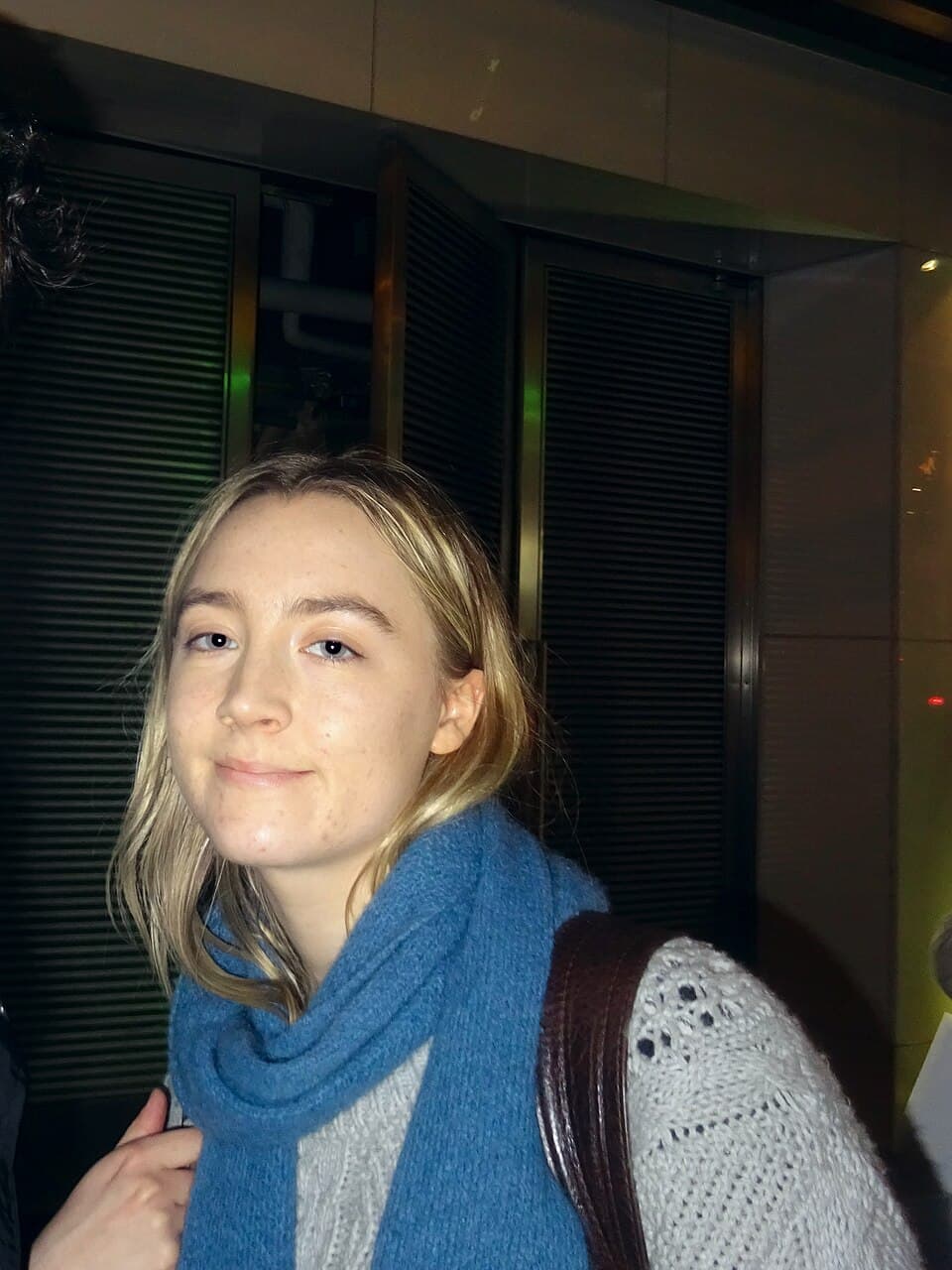
Saoirse Ronan, whose eyes are consistently described as blue in British and Irish editorial profiles.
Saoirse Ronan (26837106491) · Greg2600 · CC BY-SA 2.0 · Wikimedia resize
.jpg)
What color are Saoirse Ronan's eyes?
Blue is the answer supported by the clearest editorial evidence. British Vogue’s archived profile was written after meeting Ronan and repeatedly describes blue, using opalescent and icy as expressive modifiers. The writer notes that gray weather dimmed the color while it remained recognizably blue, then identifies her father as the source of the same family feature. That combination of direct observation, changing ambient light and a visible family resemblance is unusually useful for an editorial reference, even though it is not a clinical color assessment.
The Irish Times independently describes clear blue eyes in a career profile, and Time Out observes blue eyes during an interview. British Vogue’s later beauty coverage again calls them blue while discussing makeup choices. These sources do not all copy one dramatic phrase; they arrive at the same ordinary category in different contexts. The evidence therefore supports blue with high confidence. It does not justify assigning a permanent digital swatch, a rare medical subtype or an exact balance between blue and gray from photographs alone.
What in-person profiles actually observed
British Vogue gives the most detailed observation. Its writer sees Ronan in an ordinary interview setting, notes that overcast weather reduces the apparent brightness and still identifies blue. That small detail is more informative than the article’s poetic language because it acknowledges variation instead of pretending the iris looks identical everywhere. “Icy” and “opalescent” capture luminosity and low pigment as perceived by the writer; they are not formal grades. The Irish Times and Time Out use simpler blue wording and provide independent agreement.
The sources also show how celebrity descriptions accumulate. One writer emphasizes clarity, another brilliance and another the way the eyes hold attention. Those are judgments about presence, not competing colors. A reliable article separates the stable claim from the rhetoric surrounding it: blue is repeated, while the metaphors change. The Guardian’s review of The Seagull similarly comments on outdoor light favoring Ronan’s blue eyes, reinforcing the role of conditions without suggesting that illumination changes the underlying iris pigment.
Why her blue eyes shift on screen
Ronan’s filmography places the same face inside very different visual systems. Soft daylight in a period drama, hard desert sun, a cool interior grade and a warm awards photograph each distribute light differently. White balance can make blue appear icier or grayer, while exposure changes how much radial iris texture survives. Pupil size alters the amount of visible colored tissue, and makeup can increase or soften contrast. The British Vogue profile’s observation about gray weather is a practical example of this normal perceptual variation.
A Guardian review notes how outdoor light works with Ronan’s hair and blue eyes, while British Vogue beauty coverage describes pastel shadows and colored liner used to illuminate them. Neither source implies a biological change. Photographic iris research relies on standardized illumination and camera settings because uncontrolled pictures are not repeatable measurements. A frame from Brooklyn and a flash photograph from a premiere can both be authentic while producing different shades. They document appearances under particular conditions, not two different natural eye colors.
The Host contact lenses: a role-specific effect
The Host creates a useful but easily misunderstood contact-lens story. E! reported that performers wore unusual blue lenses to represent the film’s alien characters and quoted Ronan discussing how difficult it was to see through them at first. This is direct evidence of a production effect in one named role. It is not evidence that her ordinary blue appearance comes from cosmetic lenses, nor does wearing a blue lens mean the natural iris beneath it was a different broad color.
That distinction should remain explicit wherever the article mentions contacts. Costume departments use lenses to create a uniform supernatural appearance, alter texture, add brightness or support visual-effects work. The lens can therefore be blue even when the performer already has blue eyes. The source does not provide a before-and-after measurement or claim to replace Ronan’s natural color. It simply records a demanding piece of character design. Generalizing from that production to every film, interview or red carpet would turn accurate evidence into an unsupported rumor.
Are her eyes gray, unusually rare or heterochromatic?
Some photographs can reasonably create a blue-gray impression, especially under overcast light or a desaturated grade. Cleveland Clinic notes that experts do not always divide eye colors into identical categories and that light irises can contain complex patterning. That background explains why an observer may favor gray in one image. It does not outweigh repeated, attributable blue descriptions. The safest answer preserves the common category and allows for gray-looking appearances rather than turning a screen capture into a new permanent label.
The reviewed person-specific sources do not report heterochromia, a stable difference between the eyes or a diagnosed iris condition. They describe the eyes together as blue. Nor do they establish an extraordinarily rare proprietary shade. “Opalescent” and “icy” belong to magazine prose, not medicine. If a future first-person or clinical source documents a more specific feature, the reference can be revised. Until then, adding heterochromia or a precise subtype would create a claim that the current evidence does not contain.
How this eye-color claim was verified
The evidence was ranked by proximity and attribution. British Vogue, The Irish Times and Time Out provide explicit observations in interview or profile settings. The Guardian adds a production-specific observation about outdoor light, while later British Vogue beauty coverage independently retains the blue label. E!’s report is used for a narrow purpose: it verifies special lenses in The Host. None of these sources is treated as a calibrated eye examination, but their agreement is substantially stronger than fan lists or a color sampled from a compressed photograph.
The final wording records both conclusion and limit. Ronan’s eyes are blue according to repeated reputable descriptions; they can look paler, grayer or more luminous under different conditions. The Host lenses were a role effect and are not generalized. The page does not infer genetics beyond the family observation made by British Vogue, diagnose heterochromia or turn resemblance into identity evidence. Readers examining their own eyes should use even light and an unfiltered image, and seek an eye-care professional for any new physical change rather than comparing it with a celebrity photograph.
Questions, answered carefully
Sources and what they support
Each source is attached to a specific claim. The portrait is licensed editorial imagery and is not treated as diagnostic evidence.
01 · British Vogue
When Vogue Met A Teenage Saoirse Ronan
Editorial profileSource checked September 2, 2026
The in-person profile calls Ronan’s eyes icy blue and notes the shared family resemblance.
Open source02 · The Irish Times
Saoirse Ronan: bold before her time
Editorial profileSource checked September 2, 2026
The Irish Times describes Ronan’s eyes as clear blue.
Open source03 · Time Out
Interview: Saoirse Ronan
Editorial profileSource checked September 2, 2026
The interviewer observes Ronan’s blue eyes during their meeting.
Open source04 · British Vogue
Saoirse Ronan Beauty Looks
Editorial profileSource checked September 2, 2026
The beauty feature explicitly discusses makeup used to illuminate Ronan’s blue eyes.
Open source05 · The Guardian
The Seagull review
Editorial profileSource checked September 2, 2026
The film review discusses how outdoor light photographs Ronan’s blue eyes.
Open source06 · Eye (Nature) via PubMed Central
A novel eye color classification scale for epidemiological studies
Scientific referencePublished December 13, 2013Source checked September 2, 2026
Reproducible photographic iris grading depends on standardized illumination, camera settings and processing.
Open source07 · E! Online
Why The Host Is Not Easy on the Eyes
Editorial profileSource checked September 2, 2026
The production report documents blue contact lenses worn for The Host as a character-specific effect.
Open source08 · Cleveland Clinic
Eye Colors
Eye-health referenceSource checked September 2, 2026
Eye-color labels describe broad categories rather than universally agreed standardized shades. Hazel can combine visible brown, gold and green tones.
Open source