
Ryan Gosling · Actor and musician
Ryan Gosling's Eyes: Blue or Brown in The Notebook?
Blue is supported by Gosling’s quoted comparison and independent profiles; the brown eyes in The Notebook were continuity lenses chosen to match older Noah.
- Evidence status
- In-person profiles + production evidence
Last reviewed September 2, 2026
By Iris Analyzer Editorial Team
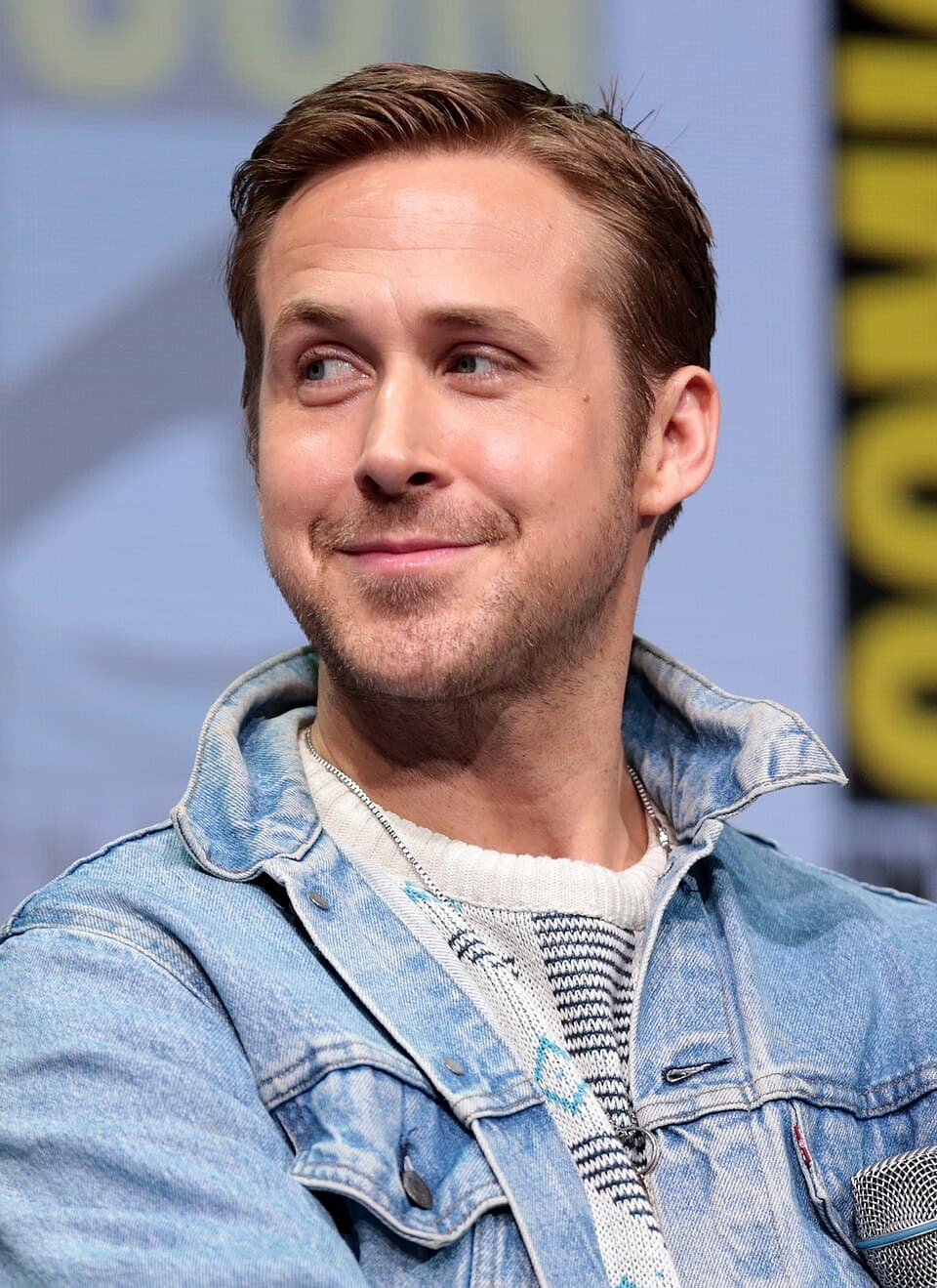
Ryan Gosling, whose blue eyes were covered by brown continuity lenses for The Notebook.
Ryan Gosling by Gage Skidmore · Gage Skidmore · CC BY-SA 3.0 · Wikimedia resize

What color are Ryan Gosling's eyes?
Blue is the answer supported by both production history and independent observation. E! Online recounts director Nick Cassavetes’s story of Gosling comparing himself with James Garner before The Notebook: “I have blue eyes. You have brown eyes.” The exchange led to brown contact lenses for young Noah. Although the first-person line is preserved through the director rather than a direct Gosling recording, its specificity and production context make it strong evidence.
Two unrelated in-person profiles agree. Maclean’s met Gosling at a beachfront bar in Cannes and described the blue eyes that become electrifying on screen. The National interviewed him at a London hotel and referred to his blue eyes during the conversation. Those observations come from different outlets and settings, and neither depends on The Notebook’s altered appearance. Together they establish blue more securely than a screenshot, fan biography or listicle could.
What was the blue-versus-brown conversation?
Cassavetes’s anecdote centers on Gosling’s methodical effort to connect young Noah with Garner’s older version. Gosling raised accents, eye color and hair, explicitly noting the blue-brown mismatch. Garner’s relaxed answer left the choice to him, and Gosling decided on contacts. E!’s account is valuable because it identifies the speakers, the continuity problem and the practical solution rather than merely asserting that a celebrity once wore lenses without a traceable production reason.
The evidence should be described precisely. Gosling’s words are first-person in content but secondhand in transmission because the director recounts them. That is why a well-supported label is more cautious than treating the E! article as a filmed eye-color confession. The claim does not rely on the anecdote alone: two in-person profiles identify blue, and Garner independently confirms the brown-lens decision. Multiple evidence types converge while their different levels of proximity remain visible.
What did in-person profiles observe?
Maclean’s begins with Gosling seated for an interview in Cannes, wearing thick horn-rimmed glasses. The reporter contrasts his cautious gaze in person with the laser intensity that makes his blue eyes electrifying on screen. Later, the same feature calls a close-up glacier-blue. That wording usefully separates ordinary encounter from cinematic impact while keeping both impressions inside the same broad blue category. The glasses and camera change presentation, not natural color.
The National supplies a plainer independent observation from a London hotel interview, describing Gosling as he smiles and moves his blue eyes. It does not discuss contacts or build a theory from a movie still. Agreement between this straightforward encounter, the Maclean’s profile and the Notebook production story reduces the chance that the answer reflects a single stylized role. None of these sources reports a natural brown classification or a stable color difference between his eyes.
Why can his blue eyes look icy or gray?
“Electric,” “glacier” and “icy” describe visual force and temperature, not separate biological categories. Light blue irises can lose saturation in shade or acquire a steel-gray cast in a cool scene. Strong directional light and a bright catchlight may instead make the separation between iris and pupil feel sharper. Gosling’s glasses, surrounding wardrobe and the color palette of a film also change contrast, affecting which qualities an interviewer or viewer notices first.
Photographic iris studies rely on controlled illumination, fixed camera settings and references because casual comparisons are unreliable. A Drive close-up, a warm awards photograph and a neutral interview are designed and processed differently. Cleveland Clinic’s eye-color overview also emphasizes broad categories rather than every poetic shade name. The strongest conclusion is therefore blue with variable apparent brightness. A single gray-looking frame does not overturn independent in-person reporting or demonstrate that the iris itself changed.
Why are his eyes brown in The Notebook?
The brown appearance was a continuity choice. E! reports that Gosling covered his blue eyes with brown contact lenses because Garner, who played the older Noah, had brown eyes. The anecdote captures Gosling actively identifying the mismatch and choosing the lenses. James Garner separately told an interviewer that the production lightened his own hair while Gosling darkened his hair and wore brown contacts. That production-participant corroboration makes the explanation stronger than recycled movie trivia.
This does not mean every brown-looking Gosling image uses contacts. Shadow, warm grading or a small pupil can also change how a light iris reads in a frame. The sourced claim is narrow: The Notebook used brown lenses to connect two actors playing Noah at different ages. It does not establish routine cosmetic lens use, a natural brown eye color or heterochromia. Outside that named production, the independent profiles continue to describe Gosling’s eyes as blue.
How this eye-color claim was verified
Verification started with Cassavetes’s detailed account of Gosling identifying his blue eyes and choosing brown continuity contacts. It was checked against Garner’s independent production recollection and against Maclean’s and The National, whose reporters met Gosling and described blue eyes. These sources answer complementary questions: the profiles establish ordinary appearance, while the production accounts explain the most famous brown-eyed exception. General references clarify why screen color is not a standardized measurement.
The resulting statement remains bounded. Gosling’s natural eyes are blue; The Notebook used brown contacts; cinematic adjectives such as glacier-blue describe presentation rather than a distinct color class. The reviewed sources do not establish natural brown eyes, routine colored contacts across his work or heterochromia. Readers should also distinguish entertainment research from health advice: a sudden change in their own iris appearance, especially with discomfort or visual symptoms, warrants assessment by an eye-care professional.
Questions, answered carefully
Sources and what they support
Each source is attached to a specific claim. The portrait is licensed editorial imagery and is not treated as diagnostic evidence.
01 · E! Online
Secrets About The Notebook
First-person contextSource checked September 2, 2026
Director Nick Cassavetes recounts Gosling saying he has blue eyes and wearing brown contacts.
Open source02 · Maclean’s
TIFF 2011: Red-Hot Ryan Gosling
Editorial profileSource checked September 2, 2026
An in-person interview describes Gosling’s blue eyes.
Open source03 · The National
Ryan Gosling Takes a Seriously Funny Turn
Editorial profileSource checked September 2, 2026
A separate in-person interview describes Gosling’s eyes as blue.
Open source04 · Ain’t It Cool News
Mr. Beaks Interviews James Garner
First-person contextSource checked September 2, 2026
James Garner says Gosling wore brown contacts to match older Noah.
Open source05 · Cleveland Clinic
Eye Colors
Eye-health referenceSource checked September 2, 2026
Eye-color labels describe broad categories rather than universally agreed standardized shades. Hazel can combine visible brown, gold and green tones.
Open source06 · Eye (Nature) via PubMed Central
A novel eye color classification scale for epidemiological studies
Scientific referencePublished December 13, 2013Source checked September 2, 2026
Reproducible photographic iris grading depends on standardized illumination, camera settings and processing.
Open source