
Megan Fox · Actor
Megan Fox's Eyes: Blue, Gray or Colored Contacts?
Multiple major publications agree on blue; “steely” and “smoky” describe photographic character, not a change of color.
- Evidence status
- Independent editorial profiles
Last reviewed September 2, 2026
By Iris Analyzer Editorial Team
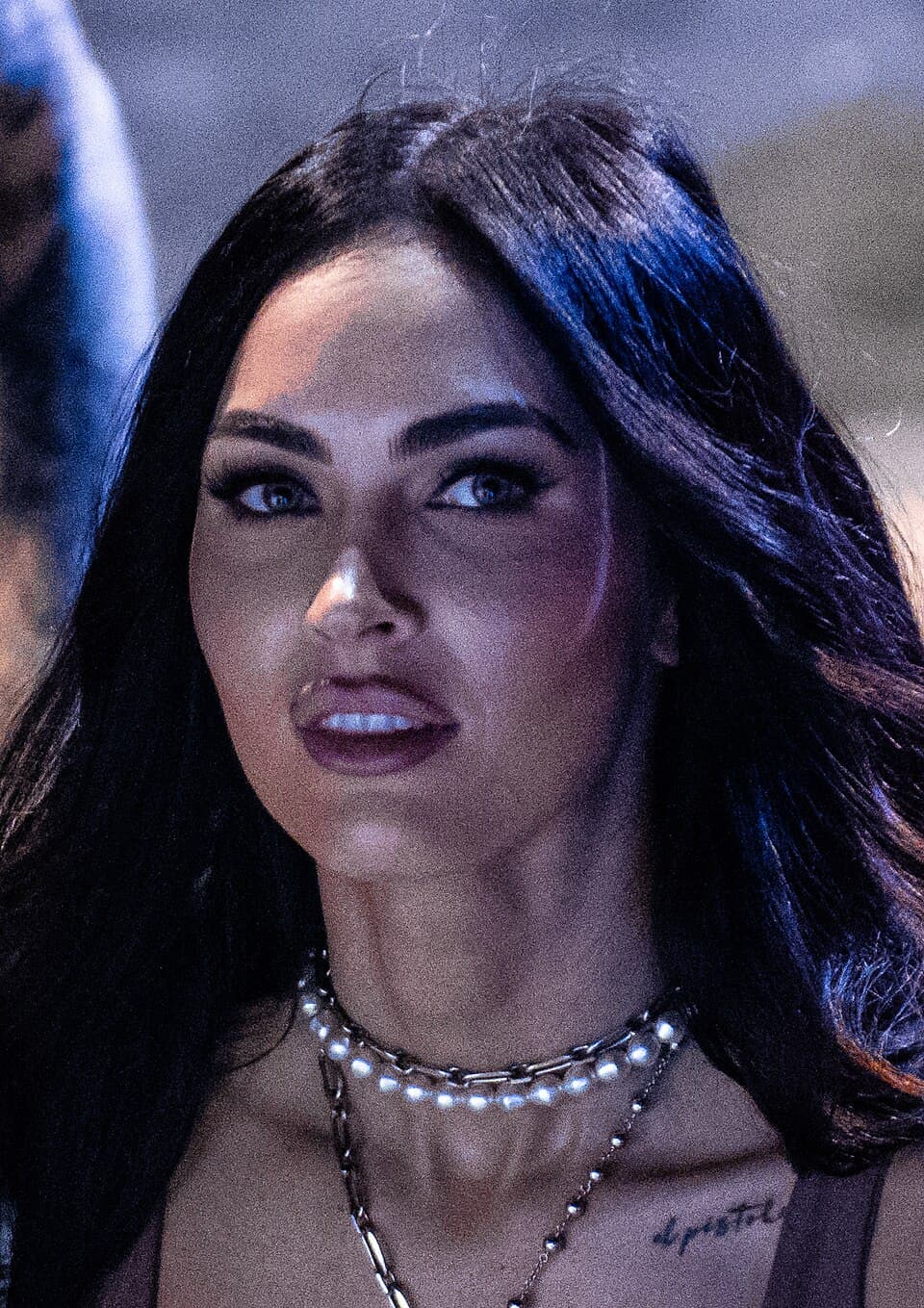
Megan Fox, whose eyes have repeatedly been described as blue by W, British GQ and Allure.
Megan Fox, 2022 (cropped) · Erik Drost · CC BY 2.0 · Commons crop; Wikimedia resize
.jpg)
What color are Megan Fox's eyes?
Blue is the answer best supported by reputable editorial evidence. A W Magazine profile refers to Fox’s blue-eyed gaze. British GQ independently describes penetrating blue eyes. Years later, Allure’s beauty coverage still uses blue, including one report saying a smoky pale-blue hair color nearly matched her eyes and another noting that turquoise styling brought out their blue. The agreement spans publications, writers and different phases of her career.
Words such as steely, penetrating and smoky should be read as descriptions of impact. They can suggest a cool or low-saturation appearance without redefining the eye as a different measurable category. None of these articles records a standardized iris grade. The most accurate summary is therefore blue, sometimes perceived as blue-gray in photographs, with no claim that a poetic adjective identifies a permanent microscopic or genetic subtype.
Why do people call them blue-gray or steel blue?
Everyday color names overlap. A lightly saturated blue can be called gray by one observer and blue by another, particularly when the iris contains darker radial texture or is photographed away from direct light. “Steel blue” combines a basic hue with an impression of coolness and muted saturation. It is useful descriptive language, but it does not mean the eyes alternate biologically between two colors.
The major profiles resolve the broad question because they repeatedly choose blue. Allure’s comparisons are especially revealing: blue hair can nearly match the eyes in one styling story, while turquoise hair and makeup can bring them out in another. Surrounding color changes contrast, making the iris feel cooler, brighter or grayer. The source-backed category remains stable even when the fashion vocabulary around it changes.
How hair, makeup and contrast amplify the color
Fox’s familiar dark-hair, dark-brow styling creates a strong light-dark contrast around a pale iris. Black liner and dense lashes can sharpen the frame, while bronzed skin or warm blush adds a complementary temperature difference. These choices do not add blue pigment to the iris; they alter the visual field in which viewers interpret it. That is why a minimal beauty look and a heavily graded campaign can produce different impressions of the same person.
Allure’s 2024 coverage provides unusually concrete examples. One hairstylist selected a pale smoky blue that the publication said almost matched Fox’s eyes. In another look, aqua hair and turquoise nails were described as bringing out the blue. Those observations belong to beauty journalism rather than clinical color science, yet they clarify the mechanism of celebrity imagery: stylists deliberately build palettes that emphasize an existing feature, and cameras preserve that designed contrast.
Why her eyes vary across movies and photographs
A finished entertainment image passes through many decisions. The scene’s key light and fill determine how much iris texture is visible. Camera exposure, lens choice and white balance affect brightness and hue. A movie’s color grade may cool shadows, warm skin or reduce overall saturation. Publicity images can then be retouched, compressed and displayed on screens with their own color settings. None of those stages is designed as neutral iris documentation.
A peer-reviewed photographic grading study used standardized light, fixed camera settings and reference photographs precisely because uncontrolled images do not support repeatable color judgments. Applying that lesson here means not letting one Transformers frame, red-carpet crop or social post outweigh explicit reporting from W, GQ and Allure. A photograph can show how Fox’s eyes appeared in that image; it cannot by itself settle an exact lifelong shade.
Are the blue eyes colored contacts?
No reliable source in the reviewed evidence establishes that Fox’s familiar blue appearance is produced by cosmetic colored contacts. W and British GQ describe her as blue-eyed in in-person profile settings, while Allure continues to use blue in later beauty reporting. None presents the color as a temporary lens effect. That does not document every costume choice in every role, but it directly undermines the habit of treating an unsourced internet allegation as a known fact.
Contact rumors often arise when a light iris looks unusually saturated in one picture or darker in another. Those shifts already have ordinary photographic explanations, and image comparison alone cannot confirm whether a transparent lens is present. A responsible article distinguishes “no credible evidence found” from the impossible claim that contacts were never worn under any circumstances. The former accurately reflects the source record; the latter would exceed it.
How the evidence was weighed
The verification method favors explicit, attributable descriptions from established publications. W and British GQ provide independent long-form observations; Allure supplies later, styling-specific corroboration. Their convergence is stronger than a fan biography copying another fan biography, and it avoids the circular logic of identifying a color from an image chosen because it already seems to prove the desired answer.
The final wording remains appropriately modest. Blue is well supported; blue-gray is a reasonable description of some appearances; an exact steel, ice or sapphire subtype is not measured. The sources do not support cosmetic-contact rumors, and they do not justify claims about personality, ancestry or health. Anyone comparing an iris should use a clear, evenly lit image and treat the result as a description of that photograph, not a celebrity match or medical finding.
Questions, answered carefully
Sources and what they support
Each source is attached to a specific claim. The portrait is licensed editorial imagery and is not treated as diagnostic evidence.
01 · W Magazine
Megan Fox
Editorial profileSource checked September 2, 2026
W Magazine describes Megan Fox's eyes as blue.
Open source02 · British GQ
The GQ interview: Megan Fox
Editorial profileSource checked September 2, 2026
British GQ independently uses a blue-eye description.
Open source03 · Allure
Megan Fox's Blue Hair
Editorial profileSource checked September 2, 2026
The beauty feature shows how surrounding blue styling can frame the eyes.
Open source04 · Allure
Megan Fox's Turquoise Nails and Crystal Tears
Editorial profileSource checked September 2, 2026
The beauty feature documents color styling around Fox’s eyes.
Open source05 · Eye (Nature) via PubMed Central
A novel eye color classification scale for epidemiological studies
Scientific referencePublished December 13, 2013Source checked September 2, 2026
Reproducible photographic iris grading depends on standardized illumination, camera settings and processing.
Open source