
Matthew McConaughey · Actor and producer
Matthew McConaughey's Eyes: Blue or Blue-Green?
Blue is confirmed in McConaughey’s own words and repeated by firsthand profiles; blue-green describes how the same light eyes can present, not a contradiction.
- Evidence status
- Direct statement + multiple in-person profiles
Last reviewed September 2, 2026
By Iris Analyzer Editorial Team
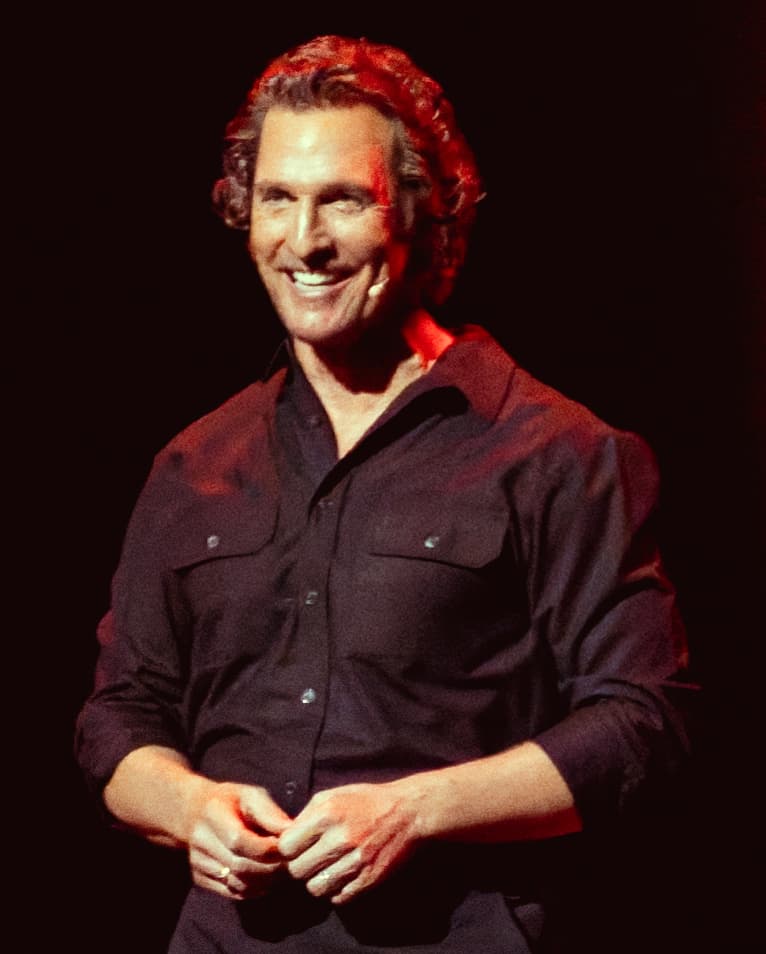
Matthew McConaughey, who directly confirmed that his blue eyes were his own rather than colored contacts.
Matthew McConaughey 2025 · Raph_PH · CC BY 4.0 · Local file unmodified

What color are Matthew McConaughey's eyes?
Blue is the clearest source-backed answer. In WIRED’s Autocomplete Interview, Idris Elba reads a question asking whether McConaughey wears contacts. McConaughey says no; Elba identifies the blue eyes, and McConaughey affirms that they are his. The exchange is informal, but it directly addresses both natural appearance and the contact-lens rumor. It is stronger evidence than a celebrity database or a shade selected from one processed movie frame.
Independent writers broadly agree. The Los Angeles Times describes blue eyes during an interview in his van, and a New Statesman writer notices blue eyes while meeting him in a London hotel. The National and SFGate call the gaze blue-green. Those descriptions place him near a familiar visual boundary within light eyes, but none supports brown or a stable left-right difference. Blue is the useful category, with blue-green as an honest appearance modifier.
What did McConaughey say about colored contacts?
The WIRED moment is unusually efficient evidence. Elba asks the contact question directly, McConaughey answers “No,” and the two clarify that the blue eyes visible in the interview belong to him. He is not merely agreeing with a host’s flattering adjective; he is distinguishing his own appearance from an artificial lens premise. That makes the clip both first-person color support and a direct boundary against claiming that his familiar blue appearance is manufactured.
The answer must not be stretched into a lifetime guarantee. It does not prove that McConaughey has never used clear vision correction, a medical lens or a role-specific effect in any production. It answers the question in that interview and supports his ordinary natural appearance. A claim about contacts in a named film would still require a makeup professional, production participant or direct statement. No such evidence in the reviewed sources overturns the natural-blue conclusion.
What did firsthand profiles observe?
The Los Angeles Times met McConaughey on a rainy Venice afternoon and explicitly describes blue eyes beneath his watch cap. The New Statesman encountered him after a long day of interviews and again used blue. These observations come from different countries, years and surroundings. Their agreement reinforces his own statement without pretending that journalists performed a controlled eye examination. They are independent, attributable descriptions of the broad color visible in person.
The National and SFGate add useful nuance by describing blue-green eyes or a blue-green gaze. SFGate’s wording occurs during a face-to-face interview, while The National observes his eyes narrowing as he discusses a character. Neither writer says one eye is blue and the other green. Instead, both show how a lightly pigmented iris may cross an ordinary naming boundary depending on the illumination and surrounding colors. The stable synthesis is blue, sometimes perceived as blue-green.
Why do some sources say blue-green?
Light eyes do not behave like a flat paint sample. Apparent color depends on light scattering, pupil size, reflections and contrast with skin, hair and wardrobe. A blue iris can pick up a greenish cast in warm surroundings or outdoor reflected light, while cool lighting may make it read as a deeper or grayer blue. Descriptive categories also overlap in ordinary speech, so two attentive observers can choose neighboring words without either seeing an entirely different iris.
Cleveland Clinic’s eye-color overview explains the role of pigment and light rather than presenting every visual modifier as a separate diagnosis. Photographic grading research uses standardized cameras, illumination and reference samples because unrelated images are not directly comparable. McConaughey’s film stills, magazine portraits and event photographs have different exposure and color treatment. The repeated firsthand evidence should outrank pixel sampling, while the blue-green reports keep the answer from claiming an exact permanent shade.
Do roles or photographs show a different eye color?
A film’s palette can strongly change the impression of light eyes. True Detective, for example, uses deliberate contrast, shadows and desaturated environments, but a striking Rust Cohle frame is not evidence of new pigment or a contact lens. The reviewed sources do not document a color-changing lens for that role. Role behavior, narrowed eyelids and intense eye contact also change how much iris is visible and how viewers remember the gaze without changing natural color.
The sources likewise do not establish heterochromia. Blue-green variation across separate photographs is not the same as a stable difference between the left and right iris. Unequal shade, angle and catchlights can make two eyes look unlike each other for a fraction of a second. McConaughey’s own confirmation and multiple profiles support the same broad blue family. Medical claims about pupil differences or color changes should not be inferred from entertainment images or celebrity comparisons.
How this eye-color claim was verified
Verification starts with the WIRED exchange, where McConaughey directly rejects the contact premise and confirms the blue eyes as his. The Los Angeles Times and New Statesman independently use blue in person. The National and SFGate supply the compatible blue-green variation. Cleveland Clinic provides general category context, and the academic grading study explains why uncontrolled screen captures cannot settle a subtle boundary more precisely than repeated attributable observations can.
The final claim is deliberately bounded: Matthew McConaughey’s natural eyes are blue and can appear blue-green. The reviewed evidence does not establish routine colored contacts, natural green eyes as a separate fixed category, heterochromia or a medical condition. It also does not claim he has never worn any lens in any context. The answer preserves his direct statement, the agreement among blue descriptions and the legitimate nuance reported by other writers who met him.
Questions, answered carefully
Sources and what they support
Each source is attached to a specific claim. The portrait is licensed editorial imagery and is not treated as diagnostic evidence.
01 · WIRED
Matthew McConaughey Answers the Web’s Questions
First-person contextSource checked September 2, 2026
McConaughey rejects the contact-lens premise and identifies his eyes as blue.
Open source02 · Los Angeles Times
Matthew McConaughey Profile
Editorial profileSource checked September 2, 2026
An in-person profile describes McConaughey’s blue eyes.
Open source03 · New Statesman
Meeting Matthew McConaughey
Editorial profileSource checked September 2, 2026
An in-person encounter describes his blue eyes.
Open source04 · The National
Matthew McConaughey, Family Man
Editorial profileSource checked September 2, 2026
Describes McConaughey’s eyes as blue-green.
Open source05 · SFGate
Aw Shucks, It’s Matthew McConaughey
Editorial profileSource checked September 2, 2026
Provides another blue-green editorial description.
Open source06 · Cleveland Clinic
Eye Colors
Eye-health referenceSource checked September 2, 2026
Eye-color labels describe broad categories rather than universally agreed standardized shades. Hazel can combine visible brown, gold and green tones.
Open source07 · Eye (Nature) via PubMed Central
A novel eye color classification scale for epidemiological studies
Scientific referencePublished December 13, 2013Source checked September 2, 2026
Reproducible photographic iris grading depends on standardized illumination, camera settings and processing.
Open source