
Margot Robbie · Actor and producer
Margot Robbie's Eyes: Blue, Pale Blue or Azure?
Blue is the consistent answer; pale, azure and vivid are descriptive refinements, while makeup and production choices change how the color reads on camera.
- Evidence status
- In-person profiles + makeup professionals
Last reviewed September 2, 2026
By Iris Analyzer Editorial Team
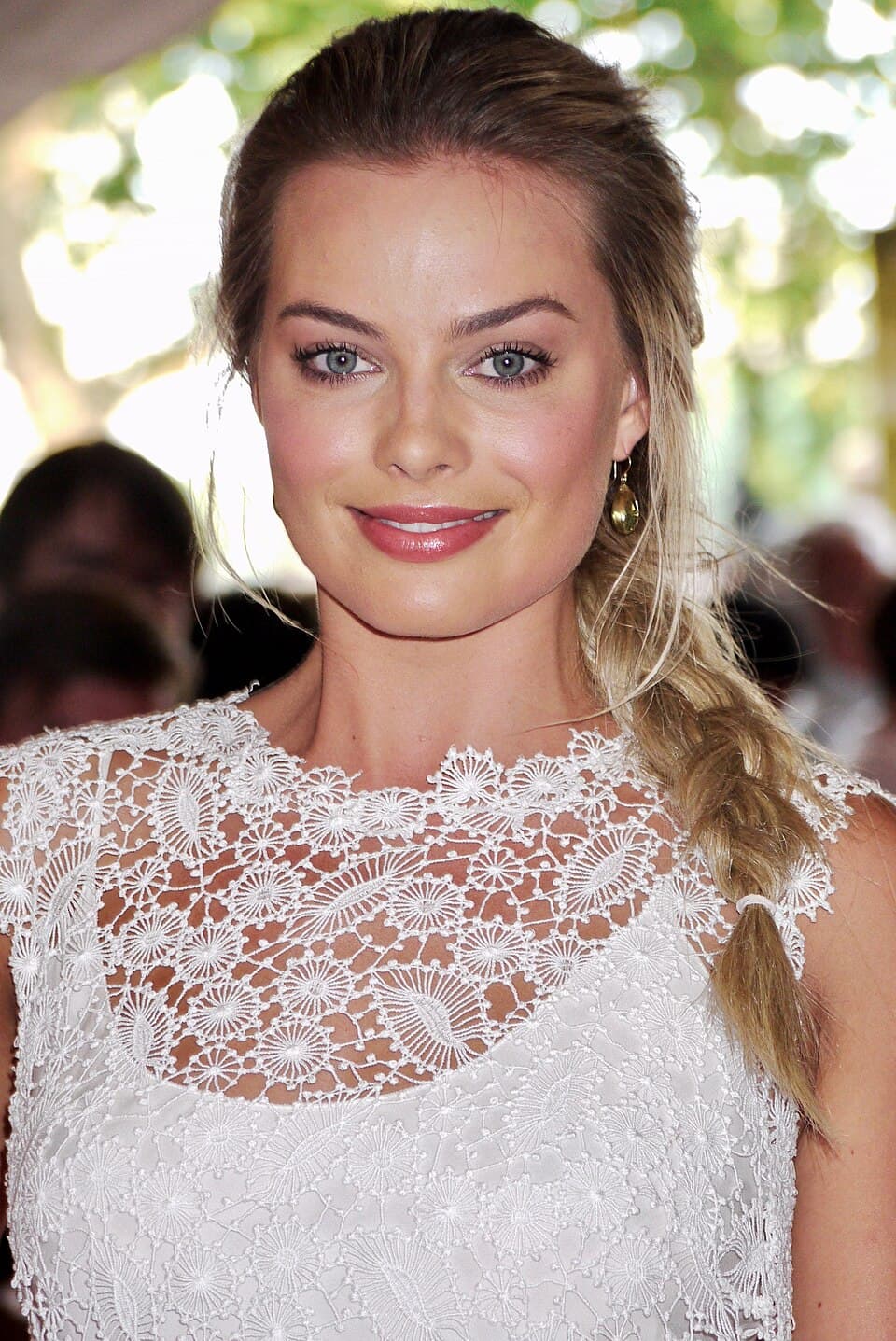
Margot Robbie, whose eyes are consistently described as blue in major profiles and professional beauty reporting.
Margot Robbie at Somerset House in 2013 (cropped) · Patrick Lovell · CC BY-SA 2.0 · Commons crop; Wikimedia resize
.jpg)
What color are Margot Robbie's eyes?
Blue is the answer supported across the strongest sources. A Vanity Fair writer who met Robbie at a New York hotel described her hair around noticeably blue eyes. British Vogue’s later in-person cover profile called them pale blue. The wording differs in intensity, but both observations place the iris in the same broad family. Neither depends on a fan-edited image, automated biography or comparison of unrelated red-carpet screenshots.
Beauty reporting points in the same direction. British Vogue described azure-blue eyes in its account of Robbie’s cover look, while Allure noted that pink shadow made her blue eyes stand out. A production makeup lead separately explained using brown mascara to enhance the blue. Together these sources make “blue” more reliable than green, gray or an exact turquoise label, while leaving room for the color to appear lighter or cooler in individual settings.
What does the in-person reporting establish?
In-person profiles carry special weight because the writer encountered Robbie outside a single finished publicity frame. Vanity Fair’s description comes from a face-to-face meeting, and British Vogue’s pale-blue wording appears in another direct profile years later. Their agreement across time and editorial teams supports a stable broad color. It also avoids overreliance on studio portraits, where retouching, lighting design and publication color management may all influence the result.
The accounts still are not clinical colorimetry. “Pale” tells readers how light the iris appeared to one writer, not its standardized pigmentation score. “Painfully blue,” the more literary Vanity Fair phrase, conveys visual impact rather than a health finding. A careful article can preserve the underlying observation while declining to repeat an adjective as scientific fact. The useful conclusion is ordinary and strong: two reputable observers, meeting Robbie in person, independently identified blue.
What do makeup professionals reveal?
Makeup coverage adds evidence from people making deliberate color choices around Robbie’s eyes. British Vogue’s account of her cover beauty describes azure-blue eyes while explaining Pati Dubroff’s warm, 1970s-inspired palette. Allure reports that a true pink eye shadow emphasized the blue, and The Set Set quotes makeup department lead Nana Fischer saying brown mascara enhanced the blue in A Big Bold Beautiful Journey. These are contextual observations by professionals attentive to color relationships.
Their comments also show why surrounding makeup cannot be ignored when judging a photograph. Pink, brown and warm neutral tones can increase contrast with blue, while black liner can make a pale iris seem more saturated. The makeup changes the visual impression, not the underlying category. None of these reports says Robbie routinely uses colored contacts, so their references to blue should not be expanded into an unsupported claim that every role or public appearance preserves an unaltered eye look.
Pale blue versus azure blue
Pale and azure are not mutually exclusive diagnoses. Pale describes lightness; azure suggests a clear, saturated blue impression. The same light iris can appear pale in soft, broad illumination and more vivid when contrast, catchlights or complementary makeup increase its apparent saturation. Camera white balance may cool or warm the result, while an image’s exposure and final grade influence how much iris detail and color reaches the viewer.
Research on photographic iris grading uses standardized light, fixed settings and reference photographs to improve agreement between observers. Fashion editorials and film coverage have different goals: they build atmosphere, flatter skin and coordinate a complete palette. That makes their shade adjectives informative but not numerically interchangeable. The responsible synthesis reports blue, notes that reputable sources have called it pale and azure, and resists turning a particular digital frame into a permanent hex code.
Roles, makeup and contact-lens rumors
Robbie’s characters often have highly designed appearances. Harley Quinn’s graphic liner and bright palette, Barbie’s coordinated pink world and period-film transformations can all change the perceived prominence of her eyes. Makeup around the iris, costume color, set design and grading belong to character construction. They may make blue appear brighter, cooler or more muted, but they do not by themselves establish a different natural eye color.
The sources reviewed for this article do not document routine cosmetic color contacts. That absence should be handled precisely: it means this evidence set cannot support the claim, not that no production has ever used a lens. A role-specific contact claim would require a makeup artist, costume record or first-person production account naming that use. Until such evidence exists for a particular appearance, screenshots and social speculation should not be promoted into a general explanation of Robbie’s blue eyes.
How this eye-color claim was verified
Verification began with two independent in-person profiles: Vanity Fair identifies blue, and British Vogue identifies pale blue. It then added professional beauty and production evidence. British Vogue’s makeup analysis uses azure-blue, Allure calls the eyes blue while discussing a complementary shadow, and a film makeup lead explicitly describes enhancing their blue with brown mascara. The convergence is stronger than a celebrity listicle because each source provides recognizable editorial or professional context.
The conclusion is deliberately bounded. It says blue without pretending that pale, azure and vivid are calibrated subtypes. It acknowledges that makeup, lighting and grading affect perceived intensity, and it does not convert character styling into a claim about anatomy. It also makes no heterochromia diagnosis and no routine contact-lens claim. Readers can use evenly lit photographs for broad comparison, but an apparent resemblance cannot verify identity, genetics, kinship, personality or eye health.
Questions, answered carefully
Sources and what they support
Each source is attached to a specific claim. The portrait is licensed editorial imagery and is not treated as diagnostic evidence.
01 · Vanity Fair
Welcome to the Summer of Margot Robbie
Editorial profileSource checked September 2, 2026
The in-person profile explicitly describes Robbie’s eyes as blue.
Open source02 · British Vogue
Margot Robbie Is Betting Big on Wuthering Heights
Editorial profileSource checked September 2, 2026
The in-person profile describes Robbie’s eyes as pale blue.
Open source03 · British Vogue
How Margot Robbie's Make-Up Artist Transformed Her
First-person contextSource checked September 2, 2026
The beauty feature describes azure-blue eyes and documents Pati Dubroff’s cover makeup.
Open source04 · Allure
Margot Robbie Keeps Finding New Ways to Wear All Pink
Editorial profileSource checked September 2, 2026
The beauty feature says pink shadow accentuated Robbie’s blue eyes.
Open source05 · The Set Set
The Hair and Makeup Easter Eggs in A Big Bold Beautiful Journey
First-person contextSource checked September 2, 2026
The production makeup lead says brown mascara was chosen to enhance the blue of Robbie’s eyes.
Open source06 · Eye (Nature) via PubMed Central
A novel eye color classification scale for epidemiological studies
Scientific referencePublished December 13, 2013Source checked September 2, 2026
Reproducible photographic iris grading depends on standardized illumination, camera settings and processing.
Open source