
Lupita Nyong’o · Actor and producer
Lupita Nyong'o's Eyes: Dark Brown, Not Black
Major profiles describe brown and dark eyes; her celebrated beauty looks demonstrate presentation, not a change in natural iris color.
- Evidence status
- Published description + in-person Vogue profile
Last reviewed September 2, 2026
By Iris Analyzer Editorial Team
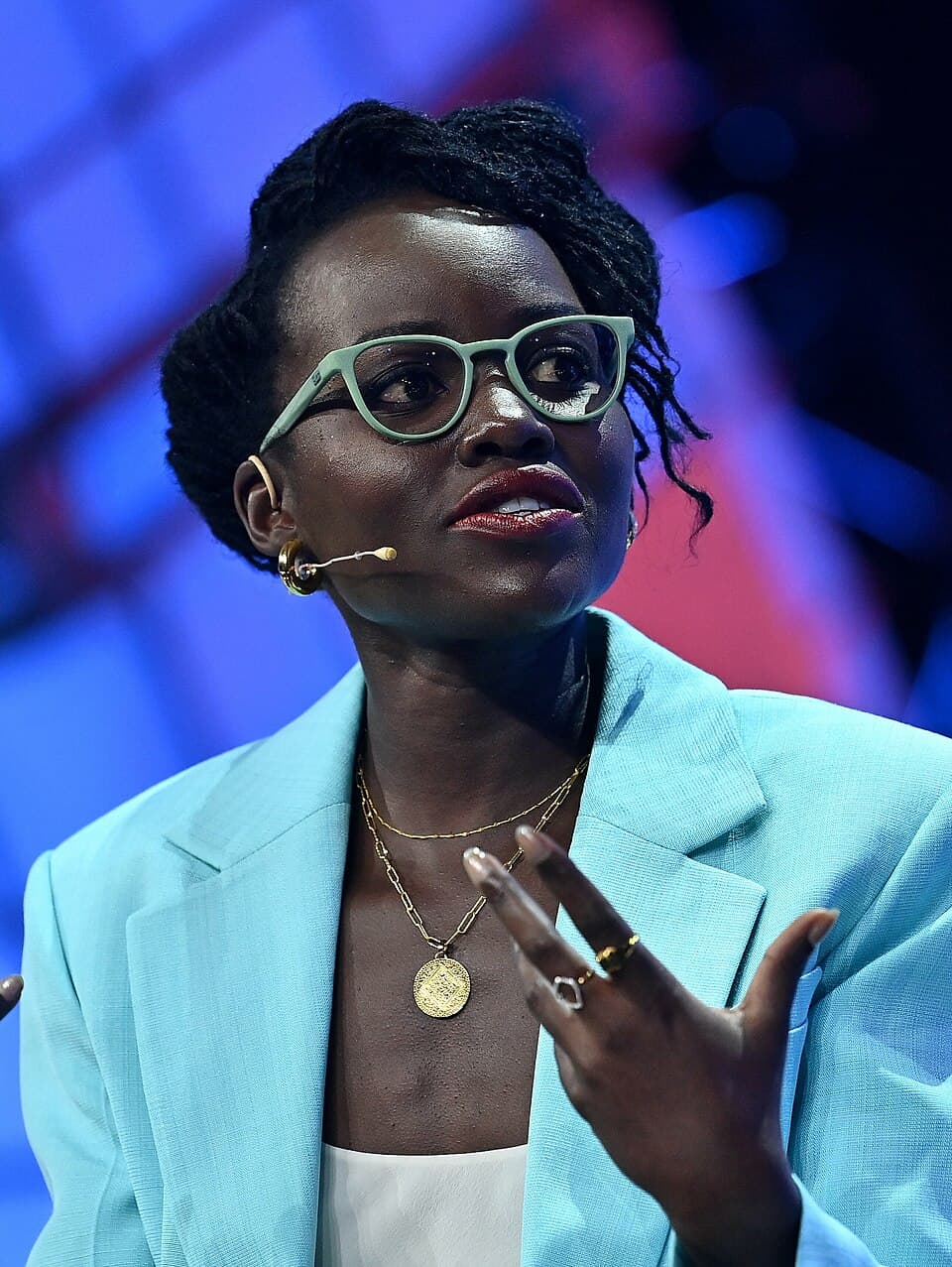
Lupita Nyong’o, whose eyes reputable profiles describe as brown and dark.
Lupita Nyong'o at Collision 2022 (cropped) · Piaras Ó Mídheach / Collision via Sportsfile · CC BY 2.0 · Commons crop; Wikimedia resize
_(cropped).jpg)
What color are Lupita Nyong'o's eyes?
Dark brown is the best synthesis of the published descriptions. In a piece about Nyong’o’s relationship with makeup and a bare-faced photograph alongside her mother, Us Weekly describes the pair as sharing big brown eyes. Vogue’s in-person Paris profile says that when Nyong’o removed blue-tinted sunglasses, she revealed wide, dark eyes beneath glittering silver shadow. One source supplies the color family; the other supplies the compatible dark appearance.
The everyday word “black” is sometimes used for very dark irises, especially when the pupil and iris are difficult to separate in a small image. Anatomically and editorially, dark brown is the more careful answer here. Neither source reports a standardized examination or exact shade, so this page does not assign a laboratory value. It preserves what the reporting can establish: Nyong’o has naturally dark brown eyes whose depth can read differently under changing light.
What the bare-faced context does—and does not—prove
The Us Weekly article draws from Nyong’o’s comments about growing up with a mother who did not consider makeup necessary. Nyong’o says she came to view makeup as an accessory used for adornment rather than concealment, and the article pairs that discussion with the mother-daughter image. The brown-eye description therefore appears in relatively natural styling context, but it is still the writer’s observation rather than a first-person color label supplied by Nyong’o.
ELLE’s direct beauty interview reinforces the distinction between natural appearance and presentation. Nyong’o discusses skin care, eyebrows, lip liner and lessons learned from makeup artist Nick Barose. Those comments are valuable because they identify the deliberate layers around the eye area, not because they measure the iris. A lightly styled photograph may reduce some variables, yet camera exposure and processing remain. The explicit brown description, not visual inference alone, carries the evidentiary weight.
How bold makeup changes the eye area without changing color
Nyong’o and Barose are known for treating the eye area as a creative canvas. Allure’s report on her 2014 Oscar look details strong brows, liquid liner and a softly defined shadow palette. Each element changes contrast: dark liner sharpens the outline of the visible eye, brows alter the upper frame, and pale or reflective shadow can make a dark iris stand out more strongly. These are changes in presentation rather than evidence of a new natural color.
Vogue’s profile offers a vivid example by noting glittering silver shadow over wide, dark eyes. Metallic particles generate highlights that may be larger and brighter than reflections inside the iris itself, particularly in flash photography. In a compressed crop, viewers can easily attribute some of that sparkle to the eye color. Reading the makeup description alongside the photograph prevents that mistake. The source keeps the categories separate: dark describes the eyes, while silver describes the cosmetic layer.
What is actually documented about colored contacts
Allure’s coverage of Nyong’o’s Divine-inspired 2019 Met Gala transformation notes that her team has used devices including colored contacts across creative looks. For that event, the detailed account focuses on an exaggerated new brow line, bronze and gold shadow, black liner, glitter and lashes. The responsible conclusion is limited: colored contacts are part of the documented repertoire of occasional fantasy styling, but the article does not say they create Nyong’o’s ordinary dark-brown appearance.
That boundary prevents two opposite errors. It would be wrong to deny all creative contact use when a reputable source directly mentions it. It would also be wrong to treat the mention as proof that every unusual photograph or red-carpet look contains a lens. Contact use should be tied to a named production or sourced look whenever possible. The natural-color answer continues to rest on the brown and dark descriptions, not on speculation about what may have been placed over the iris at another event.
Why dark brown eyes can look black—or unexpectedly bright
A photographic iris-grading study shows why controlled conditions matter. Illumination, camera settings and processing must be standardized for reproducible comparison. In ordinary event images, low exposure can merge a dark-brown iris visually with the pupil, producing an almost black appearance. Strong frontal light can do the opposite by revealing radial texture and warm reflections. Pupil size changes the amount of visible iris, while a close catchlight can make the entire eye seem brighter.
Makeup and surrounding colors amplify those effects. White or metallic liner increases edge contrast, saturated shadow can create complementary color relationships, and glossy products add reflections. None of these effects changes the pigment. They explain why searches alternate between brown, black and other impressions even when the best textual evidence is consistent. “Dark brown” respects both the explicit brown description and Vogue’s observation without turning a photographic extreme into a separate biological claim.
How the Lupita Nyong’o eye-color claim was checked
The verification chain starts with wording rather than image inspection. Us Weekly identifies brown eyes in a mother-daughter, bare-faced context. Vogue independently describes Nyong’o’s eyes as dark during an in-person encounter. ELLE supplies her own beauty philosophy, and two Allure reports show how Barose constructs everything from a softly defined Oscar eye to a deliberately theatrical Met Gala transformation. The academic study explains why those finished photographs should illustrate, not decide, the natural color.
Together, the sources support dark brown with a clear stopping point. They do not establish black irises, heterochromia, a clinical subtype or habitual colored-contact use. Creative contacts can be acknowledged where a source documents them, but that fact should not be generalized to unsourced appearances. If future first-person evidence gives a different everyday label, the page can note it. On the evidence reviewed here, dark brown is the accurate and least speculative answer.
Questions, answered carefully
Sources and what they support
Each source is attached to a specific claim. The portrait is licensed editorial imagery and is not treated as diagnostic evidence.
01 · Us Weekly
Lupita Nyong'o Was Banned from Wearing Makeup
Editorial profileSource checked September 2, 2026
The feature describes Nyong’o and her mother as sharing large brown eyes in a bare-faced photograph.
Open source02 · Vogue
Lupita Nyong'o's Second Vogue Cover
Editorial profileSource checked September 2, 2026
The in-person profile describes Nyong’o’s eyes as wide and dark after she removes tinted sunglasses.
Open source03 · ELLE
Lupita Nyong'o Spills Her Beauty Secrets
First-person contextSource checked September 2, 2026
Nyong’o provides first-person context about natural appearance, makeup and beauty styling.
Open source04 · Allure
Lupita Nyong'o's Makeup Artist on Her Oscar Look
First-person contextSource checked September 2, 2026
Makeup artist Nick Barose explains the liner, shadow and photographic styling used around Nyong’o’s eyes.
Open source05 · Allure
Lupita Nyong'o Wore Makeup Inspired by Divine
Editorial profileSource checked September 2, 2026
The feature documents a deliberately transformative eye look involving dramatic makeup and colored contacts.
Open source06 · Eye (Nature) via PubMed Central
A novel eye color classification scale for epidemiological studies
Scientific referencePublished December 13, 2013Source checked September 2, 2026
Reproducible photographic iris grading depends on standardized illumination, camera settings and processing.
Open source