
Anne Hathaway · Actor and producer
Anne Hathaway's Eyes: Brown, Source-Checked
Three independent in-person profiles describe brown eyes; blue, lilac and bronze red-carpet looks change the surrounding frame rather than the natural iris.
- Evidence status
- Repeated in-person descriptions
Last reviewed September 2, 2026
By Iris Analyzer Editorial Team
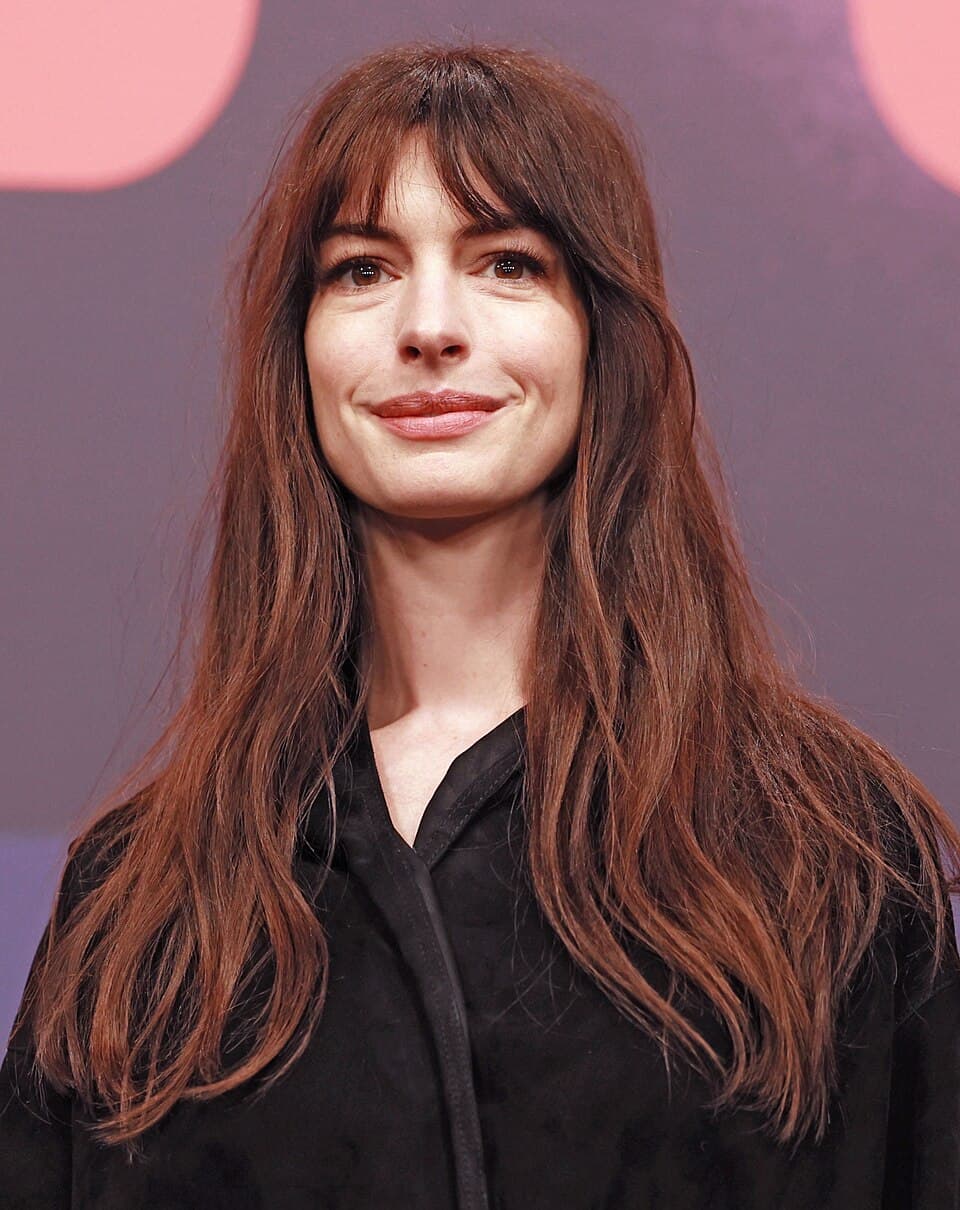
Anne Hathaway, whose eyes independent in-person profiles consistently describe as brown.
Anne Hathaway at Berlinale 2023 (cropped 2) · Elena Ternovaja · CC BY-SA 3.0 · Commons crop; Wikimedia resize
.jpg)
What color are Anne Hathaway's eyes?
Brown is the strongest source-backed answer. Interview Magazine describes Hathaway’s clear brown eyes while discussing how expressive her face is on screen. The Boston Globe independently refers to her large brown eyes during an interview for One Day, and The Independent describes giant brown eyes in an earlier in-person profile. Three separate publications therefore converge on the same broad category across different years and settings.
The word clear in one source describes their visible quality, not a separate color category. None of the profiles provides a calibrated shade name such as amber, espresso or hazel, and none reports a left-right difference. This article consequently uses brown without manufacturing greater precision. Warm highlights or a lighter ring in one photograph cannot outweigh repeated written observations made by reporters who encountered Hathaway directly.
Why three independent descriptions matter
A celebrity eye-color claim becomes more reliable when separate sources make the observation in context. Interview Magazine connects Hathaway’s brown eyes with her emotional readability. The Boston Globe places the wording inside the writer’s account of Hathaway reacting during their conversation. The Independent describes her face and eyes after noting that she appeared for the interview in jeans, striped socks and no shoes. These are reported scenes, not copied database fields.
Agreement still has limits. Editorial writers are not performing medical examinations, and broad color words do not reveal pigment concentration or genetics. The evidence warrants a well-supported brown classification, not a diagnosis or an exact digital swatch. It also does not establish that every photographed appearance is lens-free. It simply gives a far better baseline than visual guessing: three independent observers used brown, and no comparably strong reviewed source supplies a conflicting natural label.
How red-carpet makeup changes the frame
Allure’s Golden Globes report shows how a subtle look can shift perception. Makeup artist Kate Lee used grayish-lilac shadow through the crease and under the lower lashes, left the lids nude, skipped eyeliner, curled the lashes and added waterproof mascara. Cool gray and lilac beside a brown iris can reduce visible warmth, while clean surrounding skin and a bright event exposure can make the eye area look lighter than it would in ordinary indoor light.
At the 2013 Met Gala, the styling moved in the opposite direction of subtlety. Allure reports vibrant purple cream shadow, deep navy powder, black gel liner and several coats of mascara. A crop dominated by navy and purple may give the whole eye area a blue cast, especially after cool white balance or editorial grading. Those pigments are documented on the lids and lash lines. They do not make blue or violet a natural iris-color claim.
Why brown eyes can look lighter, darker or warmer
Brown irises can lose detail under low exposure because the pupil and iris visually merge, producing an almost black appearance. Bright frontal light can reveal radial texture and warmer golden or reddish reflections that a dim frame concealed. Pupil size changes the visible proportion of iris, while flash, lens characteristics, white balance, compression and screen settings determine which details survive to the viewer. None of those factors changes the underlying category by itself.
Makeup adds local contrast. Black liner can make the adjacent iris appear lighter; bronze shadow can echo warm reflections; cool lilac can make brown look more neutral; and pale skin makeup or a white gown can affect the camera’s exposure. Hathaway’s red-carpet record includes many such transformations. The appropriate use of those images is to explain photographic variety after the baseline is established, not to relabel each event as a new natural eye color.
What the sources do not establish about contacts or shade
The reviewed material does not provide reliable evidence that Hathaway routinely wears colored contacts or that contacts explain her familiar brown-eyed appearance. It would therefore be misleading to turn an unusually cool photograph into a lens claim. Colored eye shadow, dark liner, false lashes and photographic grading are all visible or documented alternatives, but even they should be assigned only to the specific event for which a source records them.
The sources likewise do not justify hazel as the baseline. Brown eyes can show warm, gold-looking detail under strong light without meeting a consistent editorial description of hazel. Nor do the profiles report heterochromia, sectoral color differences or a medically changing iris. The article’s restraint is part of its usefulness: brown is supported several times, whereas narrower shade labels and contact rumors remain unverified in this evidence set.
How the Anne Hathaway eye-color claim was checked
Verification began with sources that explicitly name the color. Interview Magazine, The Boston Globe and The Independent each describe brown eyes in the course of a reported profile. Allure’s two detailed makeup accounts then explain how gray-lilac, purple, navy, black and mascara altered the surrounding visual frame at specific events. Vanity Fair’s later cover story provides current editorial context but does not replace the earlier color evidence with a new label.
The resulting conclusion is well supported and appropriately broad. Hathaway’s natural eyes are brown in the reviewed reporting. They can look nearly black, warmer, cooler or lighter as illumination, pupil size, makeup and processing change, but those appearances do not establish hazel or blue pigment. No reviewed source documents routine colored contacts or natural heterochromia. If Hathaway or a production professional later supplies a specific lens account, it can be added as a bounded event rather than generalized backward.
Questions, answered carefully
Sources and what they support
Each source is attached to a specific claim. The portrait is licensed editorial imagery and is not treated as diagnostic evidence.
01 · Interview Magazine
Anne Hathaway
Editorial profileSource checked September 2, 2026
An in-person profile describes Hathaway’s eyes as clear brown.
Open source02 · The Boston Globe
Anne Hathaway Approached One Day as She Approaches Every Day
Editorial profileSource checked September 2, 2026
An in-person interview describes Hathaway’s large brown eyes.
Open source03 · The Independent
Anne Hathaway: The Reluctant Princess
Editorial profileSource checked September 2, 2026
A separate in-person profile also describes Hathaway’s eyes as brown.
Open source04 · Allure
Anne Hathaway’s Fresh-Faced Golden Globes Look
First-person contextSource checked September 2, 2026
The report documents gray-lilac shadow used around Hathaway’s eyes.
Open source05 · Allure
The Inside Scoop on Anne Hathaway’s 2013 Met Gala Look
First-person contextSource checked September 2, 2026
The report documents electric-blue and navy eye makeup.
Open source06 · Vanity Fair
Anne Hathaway on Tuning Out the Haters
Editorial profileSource checked September 2, 2026
A recent in-person profile supplies current career context.
Open source