
Elvis Presley · Singer and actor
Elvis Presley's Eyes: Blue or Brown in ‘Flaming Star’?
Blue is the supported natural color; brown eyes in a famous “Flaming Star” test and “The Searcher” artwork came from a documented, abandoned contact-lens experiment.
- Evidence status
- Direct observer + production history
Last reviewed September 2, 2026
By Iris Analyzer Editorial Team
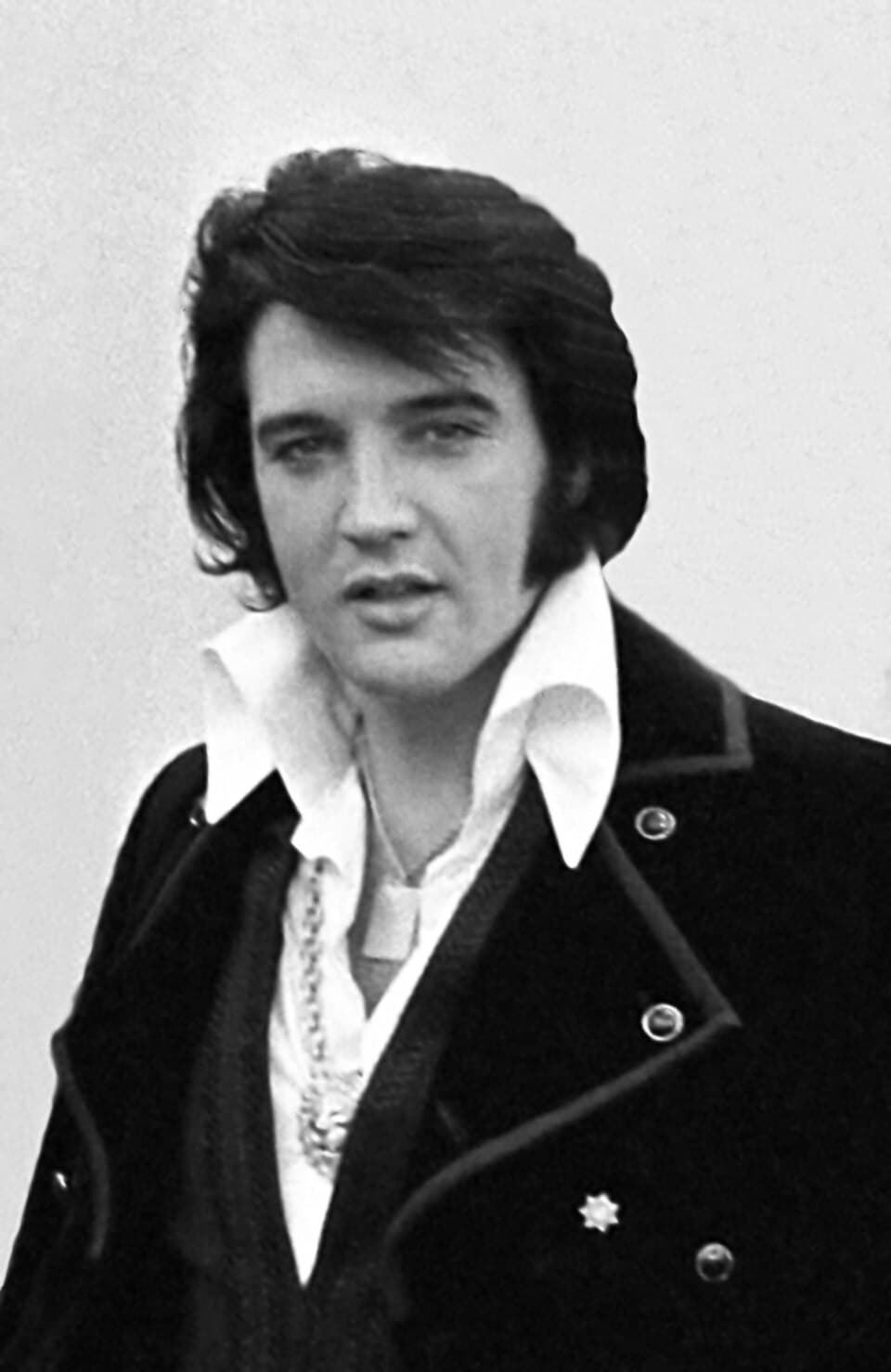
Elvis Presley, whose natural eyes were blue despite a famous brown-contact camera test for “Flaming Star.”
Elvis Presley 1970 · Ollie Atkins, White House photographer · Public domain (U.S. federal government work) · Wikimedia resize

What color were Elvis Presley's eyes?
Blue is the strongest source-backed answer. Celeste Yarnall, who acted with Presley in “Live a Little, Love a Little,” remembers his royal blue eyes while describing how striking he looked in person. Modern film-production discussion similarly refers to Presley’s signature piercing blue eyes when explaining the visual recreation built for Baz Luhrmann’s “Elvis.” The descriptive adjectives vary, but they place the natural irises in the same broad blue family.
Royal, piercing and vivid are impressions rather than calibrated subtypes. Historical observers were not using standardized iris charts, and surviving color images pass through film stock, printing, scanning and restoration. The reliable conclusion should therefore remain blue, with the more dramatic terms quoted as sourced language. Brown imagery requires a different explanation, but it does not overturn the direct record: a specific production experiment used cosmetic lenses, and one photograph from that experiment later became unusually prominent.
What happened during the “Flaming Star” contact test?
“Flaming Star” cast Presley as Pacer Burton, a character written as the son of a white father and Kiowa mother. Production chronology reports that blue-eyed Presley was fitted for brown contacts as filmmakers explored how to present the role. He was photographed wearing them in a camera or wardrobe test. The purpose was character transformation, not correction of his vision and not evidence that naturally brown eyes had been hidden throughout his career.
The experiment did not become the final baseline. The production history says the lenses ultimately were not used in the role, while USA Today’s account of the later documentary says the plan was discarded once filming began. That scope should be preserved carefully: Presley did wear brown contacts for the documented test, but it is misleading to say simply that he wore brown contacts throughout “Flaming Star.” Test photography and final principal photography are different evidentiary contexts.
Why does “The Searcher” artwork show brown eyes?
The brown-contact test photograph gained a second life decades later as the key image for HBO’s “Elvis Presley: The Searcher.” USA Today identifies the image’s “Flaming Star” test origin and explains that Presley’s natural eyes were blue. Because the documentary was an authoritative, widely promoted production, viewers reasonably encountered its poster without knowing that the portrait documented a discarded character experiment. Reuse converted a narrow production artifact into a recurring online color mystery.
Apple TV’s listing establishes the documentary context and its use of extensive archival material and primary-source interviews. That pedigree makes the film important, but it does not turn every piece of its artwork into an unstyled natural-color reference. The key portrait was selected for visual power, not iris measurement. An article should name both truths together: “The Searcher” uses a genuinely historical Elvis photograph, and that particular photograph shows a brown cosmetic-contact test rather than his ordinary blue eyes.
How do makeup and historical film change the look?
Los Angeles Times reporting notes that early Presley used blue eye shadow and mascara to accentuate his eyes. Dark lash definition can make a light iris appear clearer, while blue shadow may reinforce or stylize the surrounding color. Stage lamps, squinting and pupil size further change how much iris texture is visible. These choices help explain why the eyes can look intensely blue in one publicity image and muted or dark in another without any contact lens being present.
Historical color introduces additional uncertainty. Film stocks reproduce blues differently, prints fade, scans inherit color casts and restorers make creative judgments. Modern biographical cinema adds deliberate grading; Post Magazine’s discussion calls out the importance of Presley’s piercing blue eyes within a consciously shaped visual system. Iris-grading research relies on standardized capture because uncontrolled pictures cannot be compared as measurements. The brown test is known from production evidence; other shade differences should not be assigned to lenses by appearance alone.
Did Elvis routinely wear contacts or have heterochromia?
The reviewed evidence supports brown contacts for a particular “Flaming Star” test, not routine cosmetic-contact use. That documented exception should not be expanded to concerts, private life or every photograph in which blue is hard to see. The production abandoned the proposed final-role use, and a co-star independently remembers royal blue eyes in person. Outside the test, any lens claim would need its own first-person or production documentation.
The sources also do not establish heterochromia. They describe the eyes collectively as blue, and the brown-contact history concerns a planned matched transformation rather than a natural difference between sides. Uneven shadow, degraded color, a damaged print or different reflections can make one eye look darker in archival imagery. Those effects are not a diagnosis. The responsible conclusion is naturally blue eyes, one verified brown-contact test and no substantiated stable left-right pigment difference.
How this eye-color claim was verified
Verification treated natural observation and role transformation as separate questions. Yarnall supplies a direct recollection of royal blue eyes. The “Flaming Star” chronology records fitting blue-eyed Presley with brown contacts and says they were not ultimately used in the role. USA Today traces the test photograph into “The Searcher” marketing, and Apple TV establishes the documentary context. The sources explain the famous brown image rather than merely outvoting it with other photographs.
Los Angeles Times reporting adds historical eye-makeup context, while Post Magazine shows how modern filmmakers and colorists deliberately recreate a piercing-blue signature. The photographic study supplies the methodological limit for comparing uncontrolled archival frames. The resulting answer is bounded but confident: natural blue, vivid in some first-hand descriptions, with a documented brown-contact camera test that was abandoned for final filming. No routine contact use, heterochromia, health diagnosis or exact digital blue subtype is asserted.
Questions, answered carefully
Sources and what they support
Each source is attached to a specific claim. The portrait is licensed editorial imagery and is not treated as diagnostic evidence.
01 · Elvis Australia
Interview With Celeste Yarnall
First-person contextSource checked September 2, 2026
Presley’s co-star recalls his royal-blue eyes.
Open source02 · Post Magazine
Elvis: Color Grading Warner Bros.’ Feature
First-person contextSource checked September 2, 2026
The production discussion covers recreating piercing blue eyes through grading.
Open source03 · USA Today
Elvis the Artist: The Searcher Finds Rescue
Editorial profileSource checked September 2, 2026
The report explains that blue-eyed Presley wore brown contacts for a test image.
Open source04 · Elvis Australia
Flaming Star: 20th Century Fox 1960
Editorial profileSource checked September 2, 2026
The production history says brown contacts were tested but not retained.
Open source05 · Apple TV
Elvis: The Searcher
Editorial profileSource checked September 2, 2026
The listing establishes the documentary tied to the brown-contact test image.
Open source06 · Los Angeles Times
A Book, a Book o’ Burning Love
Editorial profileSource checked September 2, 2026
The report says Presley used blue shadow and mascara to accentuate his eyes.
Open source07 · Eye (Nature) via PubMed Central
A novel eye color classification scale for epidemiological studies
Scientific referencePublished December 13, 2013Source checked September 2, 2026
Reproducible photographic iris grading depends on standardized illumination, camera settings and processing.
Open source