
What Determines Eye Color? Genes, Melanin & Light
Your iris color is the visible result of pigment, structure and light working together.
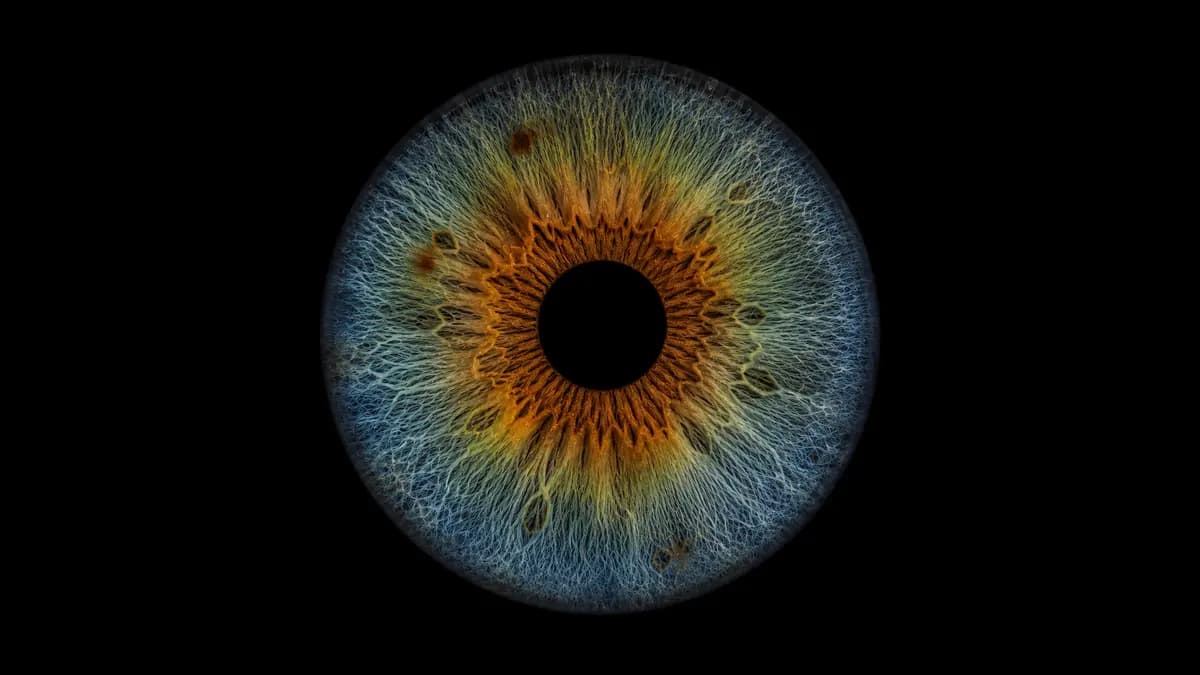
Eye color is a system, not a swatch
The color you see is the combined appearance of pigment in the iris, the microscopic structure holding that pigment and the light reaching the eye. Those factors form a continuum from very light blue through gray, green and hazel to dark brown. A broad label is useful, but it compresses a layered iris into one word.
Melanin sets the broad range
Melanin in the front layers of the iris is the main pigment behind the range. Brown eyes generally have more visible melanin there; blue eyes have much less. Green, gray and hazel appearances come from intermediate amounts, uneven distribution and optical effects—not from separate green or blue dyes hidden in the eye.
Many genes tune that pigment
OCA2 and a regulatory region in HERC2 have major roles in melanin production, but they are not an on-off eye-color switch. Large genetic studies have identified many additional loci with smaller effects. That is why the classroom rule that brown is simply dominant and blue simply recessive is only a rough shortcut, and why family eye-color predictions can surprise you.
Iris structure changes what you see
The fibrous stroma scatters light, while crypts, the collarette, radial streaks, contraction furrows and localized pigment spots create highlights, shadows and zones. A warm ring around the pupil, a cooler outer field or scattered flecks can make two irises with the same broad category look completely different in a close-up.
What a photo can—and cannot—measure
A sharp photo in indirect daylight can measure the visible color mixture and show how pigment is arranged in that image. It cannot read your genes, count melanin molecules or assess eye health. Use the same neutral lighting, camera and exposure for comparisons, and treat a new real-world color change as an eye-care question rather than a color-analysis result.
Stop guessing — measure it
Photo-based color percentages, rarity score, and a shareable Iris Card in 60 seconds. Private: your photo never leaves your device.
Analyze My Eye Color FreeFrequently asked questions
Is brown eye color always dominant over blue?
No single dominant-recessive rule explains every family. OCA2 and HERC2 have large effects, but many other genetic variants contribute, so the simple school model is an approximation.
Can two blue-eyed parents have a brown-eyed child?
It is uncommon, but the genetics are complex enough that it can happen. Parent eye colors alone do not reveal every variant a child may inherit.
Do blue or green eyes contain blue or green pigment?
The principal iris pigment is melanin, which is brown. Lighter colors emerge mainly from lower melanin, its distribution and the way iris tissue scatters and reflects light.
Can a photo tell me my eye-color genes?
No. A photo can describe visible color and pattern under the captured light. Genetic testing is a different process, and even DNA-based prediction is probabilistic rather than a perfect shade reading.