
How Unique Is Your Iris? Patterns, Twins & Biometrics
Eye color is shared by millions; the fine arrangement of an iris is far more distinctive.
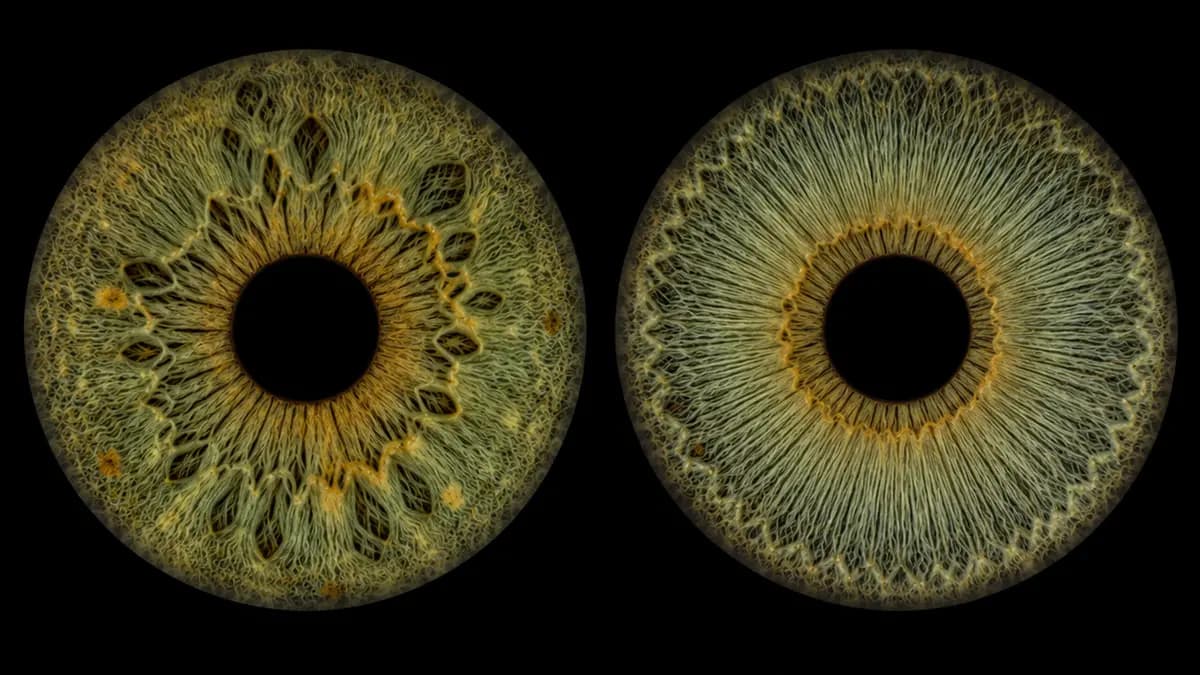
Highly distinctive is the careful answer
An iris combines radial fibers, crypts, furrows, the shape of the collarette and pigment details in an extremely information-rich texture. Biometric systems use that texture because comparisons between different irises are usually very different. Calling every iris mathematically unique is stronger than a normal photo can prove, so “highly distinctive” is the more precise description.
Color is only the first layer
Two people may both have green or brown eyes while their close-ups share almost no fine arrangement. One iris may have large crypts near the collarette, another tight radial streaks; one may show broken peripheral furrows, another scattered pigment spots. Biometrics depends on the combined texture, not on the broad color name.
What twins and two eyes teach us
Even identical twins produce different iris-recognition patterns, and a person's left and right irises are treated as separate biometric characteristics. Genes influence eye color and some surface-feature tendencies, but development does not reproduce the same detailed arrangement twice. Pattern difference does not imply anything about personality or health.
Stable does not mean every photo matches
NIST studies found no evidence of a widespread aging change in iris texture across large datasets and estimated that recognition can remain usable for decades. Yet pupil dilation, focus, angle, eyelid occlusion, reflections and sensor quality can all reduce a match. A biometric score describes an image-and-algorithm comparison, not an infallible law of nature.
Iris Analyzer is not an identity scanner
A recognition system segments the iris and converts texture into a template for comparison with enrolled records. Iris Analyzer instead measures visible colors and zones in your chosen photo, processes the image in the browser and does not search an identity database. Its pattern guides are educational descriptions, not biometric enrollment or identification.
Stop guessing — measure it
Photo-based color percentages, rarity score, and a shareable Iris Card in 60 seconds. Private: your photo never leaves your device.
Analyze My Eye Color FreeFrequently asked questions
Do identical twins have identical iris patterns?
No. Identical twins share DNA but their fine iris textures differ enough to be treated as separate patterns by iris-recognition systems.
Are my left and right irises the same?
They may share color, but their detailed crypts, fibers, furrows and pigment distribution are different. Biometric systems enroll them separately.
Does an iris pattern change with age?
It is generally stable enough for long-term recognition, but capture conditions and pupil dilation can change how the texture is imaged. Injury or eye disease can also alter appearance.
Can an ordinary iris photo identify me?
Specialized recognition requires suitable image detail, an algorithm and something to compare against. Still, biometric imagery is sensitive data, so use services with clear privacy handling and avoid unnecessary uploads.