
Zendaya · Actor and producer
Zendaya's Eyes: Brown, Source-Checked
Her longtime makeup artist identifies brown eyes; the blue, violet and metallic looks around them are creative styling, not a different natural iris color.
- Evidence status
- Longtime makeup artist + direct context
Last reviewed September 2, 2026
By Iris Analyzer Editorial Team
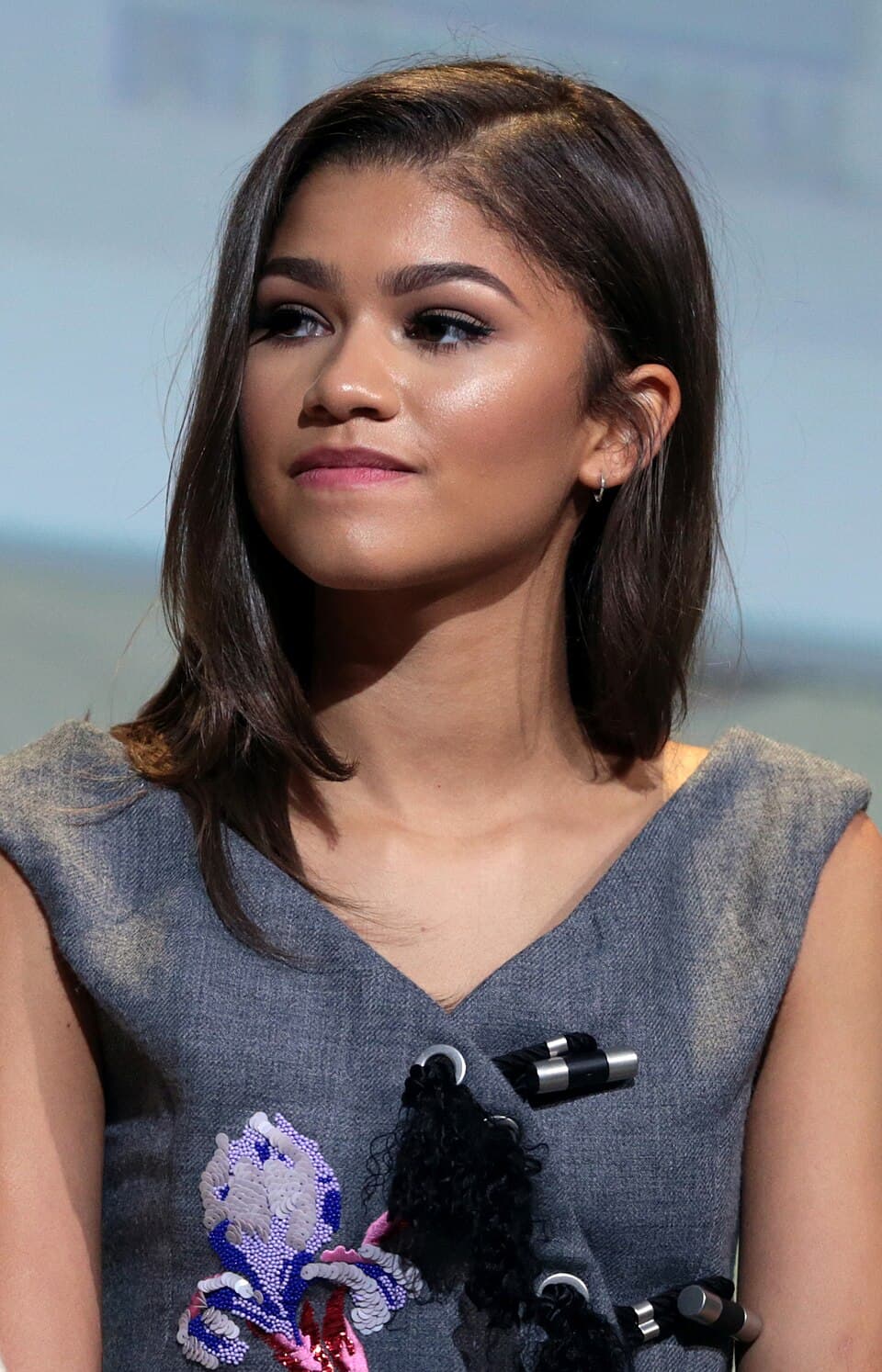
Zendaya, whose longtime makeup artist described her eyes as brown while explaining a blue-liner look.
Zendaya by Gage Skidmore · Gage Skidmore · CC BY-SA 3.0 · Wikimedia resize

What color are Zendaya's eyes?
Brown is the clearest source-backed answer. In British Vogue’s account of the beauty direction for its October 2021 issue, Zendaya’s makeup artist Sheika Daley explains that she replaced the usual brown smoky-eye palette with several blue eyeliners to flatter Zendaya’s brown eyes. That is more useful evidence than a fan color chart or a sampled pixel: it is an explicit color description from a professional who has worked on her face for years and was discussing the eye area in detail.
The source does not subdivide the color into dark brown, light brown, amber or hazel, and this profile does not manufacture a narrower category. Brown irises contain a range of visible tones, and a warm highlight in a close photograph is not enough to establish a mixed hazel pattern. The supported answer stays broad and stable: Zendaya has brown eyes. More specific claims would require equally specific evidence that the reviewed reporting does not provide.
Why blue makeup does not mean blue irises
Daley’s British Vogue explanation is also a compact lesson in color contrast. Blue liner can make a brown iris appear warmer or brighter because the eye is judged alongside the colors surrounding it. The publication describes multiple blue liners and shadows being layered into an almond-shaped smoky eye. The blue belongs to the cosmetic design on the lids and lash line; it is not a report that Zendaya’s natural irises became blue or that blue contact lenses were used.
That distinction matters because beauty headlines often use phrases such as “blue eyes,” “bronze eyes” or “violet eyes” to name a makeup look rather than an iris color. Zendaya’s editorial history includes many strong-eye concepts, and isolated photographs circulate after their captions and product notes disappear. Restoring the styling context resolves much of the apparent mystery. A dramatic sapphire or pastel frame can alter perception while the underlying brown iris remains unchanged.
What Zendaya says about makeup and her natural face
Zendaya’s first-person interviews provide context without pretending that she personally issued an eye-color declaration. In Vogue’s 73 Questions, she says she favors a strong eye, often does her own event makeup and learned by observing makeup artists. In ELLE, she describes makeup as fun and experimental—closer to painting on her face than correcting a flaw—and says she is comfortable appearing without it. Those comments explain why her public images cover such a wide visual range.
They also help separate identity from styling. A bare-faced image may show more of the natural eye area, but it is still a photograph made under one light and camera setup. A red-carpet image may add liner, shadow, lashes and retouching, yet those choices do not make it dishonest; they make it designed. The reliable color answer comes from Daley’s explicit brown-eye description, while Zendaya’s interviews tell us how willingly she moves between minimal and highly constructed presentations.
How an editorial eye look is built around color
Allure’s behind-the-scenes account of Zendaya’s 1970s-inspired cover shows why a finished image should not be read as a neutral iris record. Daley says the team reviewed references, chose color-washed eyes and custom-mixed shadows instead of taking a product straight from the pan. Zendaya participated in the visual decisions. The resulting eye area was therefore a collaboration among performer, makeup artist, stylist, photographer and publication rather than an accidental snapshot of natural color.
Custom shadow can change the local color balance around the iris, while liner defines the visible boundary and lashes change how much light reaches the eye. Photography adds another layer through exposure, white balance, contrast and later processing. None of this prevents viewers from enjoying or comparing the looks. It simply means the editorial frame answers a question about creative presentation, while the natural-color question should be answered with explicit reporting that identifies the iris rather than the cosmetics.
Why the same brown eyes can look different on camera
A peer-reviewed study proposing a photographic eye-color grading scale emphasizes standardized illumination, camera settings and processing. Celebrity stills rarely meet those conditions. Warm event lighting can emphasize golden components within a brown iris; cool light and blue surroundings can change the perceived balance; a large pupil can leave less visible iris; and a close catchlight can reveal texture that disappears in a darker frame. Display settings and social-media compression introduce still more variation.
For that reason, selecting one high-resolution portrait and assigning a permanent digital swatch would create false precision. A pixel records the finished file after the scene has passed through optics, a sensor, color correction and a screen. It does not independently reveal a biological category. Repeated photographs are helpful for illustrating variation, but they should remain subordinate to the written evidence. Here, that evidence says brown and does not provide grounds for promoting occasional warm reflections into amber or hazel.
How the Zendaya eye-color claim was checked
Verification began with a source that actually names an iris color. British Vogue supplies brown through Daley’s professional explanation. Vogue and ELLE add Zendaya’s own comments about strong-eye looks, self-applied makeup and feeling comfortable without cosmetics. Allure documents a custom-built editorial eye treatment. Cleveland Clinic supplies broad eye-color context, and the photographic grading study establishes why uncontrolled pictures should not overrule a clear textual description.
The resulting conclusion is confident but bounded. Zendaya’s natural eyes are brown in the reviewed evidence. There is no reliable support here for hazel, amber, heterochromia or habitual colored contacts, and the blue looks are documented cosmetics rather than proof of blue irises. If a future first-person or production source adds more detail, the profile can be revised. Until then, “brown” is both the simplest answer and the one that best matches the strongest available reporting.
Questions, answered carefully
Sources and what they support
Each source is attached to a specific claim. The portrait is licensed editorial imagery and is not treated as diagnostic evidence.
01 · British Vogue
The Secret To Zendaya's Soft Glam Beauty Look
First-person contextSource checked September 2, 2026
Zendaya’s longtime makeup artist says blue liner was chosen to flatter Zendaya’s brown eyes.
Open source02 · Cleveland Clinic
Eye Colors
Eye-health referenceSource checked September 2, 2026
Eye-color labels describe broad categories rather than universally agreed standardized shades. Hazel can combine visible brown, gold and green tones.
Open source03 · Allure
How Zendaya Got Her 1970s Hair and Makeup
First-person contextSource checked September 2, 2026
Her makeup artist describes custom-mixed color washes around the eyes for an editorial shoot.
Open source04 · Vogue
73 Questions With Zendaya
First-person contextSource checked September 2, 2026
Zendaya discusses doing her own makeup and her preference for emphasizing the eyes.
Open source05 · ELLE
Zendaya on Natural Hair, Drugstore Makeup, and Perfect Eyebrows
First-person contextSource checked September 2, 2026
Zendaya explains that she treats makeup as experimentation and often goes without it off duty.
Open source06 · Eye (Nature) via PubMed Central
A novel eye color classification scale for epidemiological studies
Scientific referencePublished December 13, 2013Source checked September 2, 2026
Reproducible photographic iris grading depends on standardized illumination, camera settings and processing.
Open source