
Winona Ryder · Actor
Winona Ryder's Eyes: Brown, in Her Own Words
Ryder herself calls her eyes brown, and independent profiles from the Los Angeles Times and Vogue report the same color.
- Evidence status
- Direct statement + in-person corroboration
Last reviewed September 2, 2026
By Iris Analyzer Editorial Team
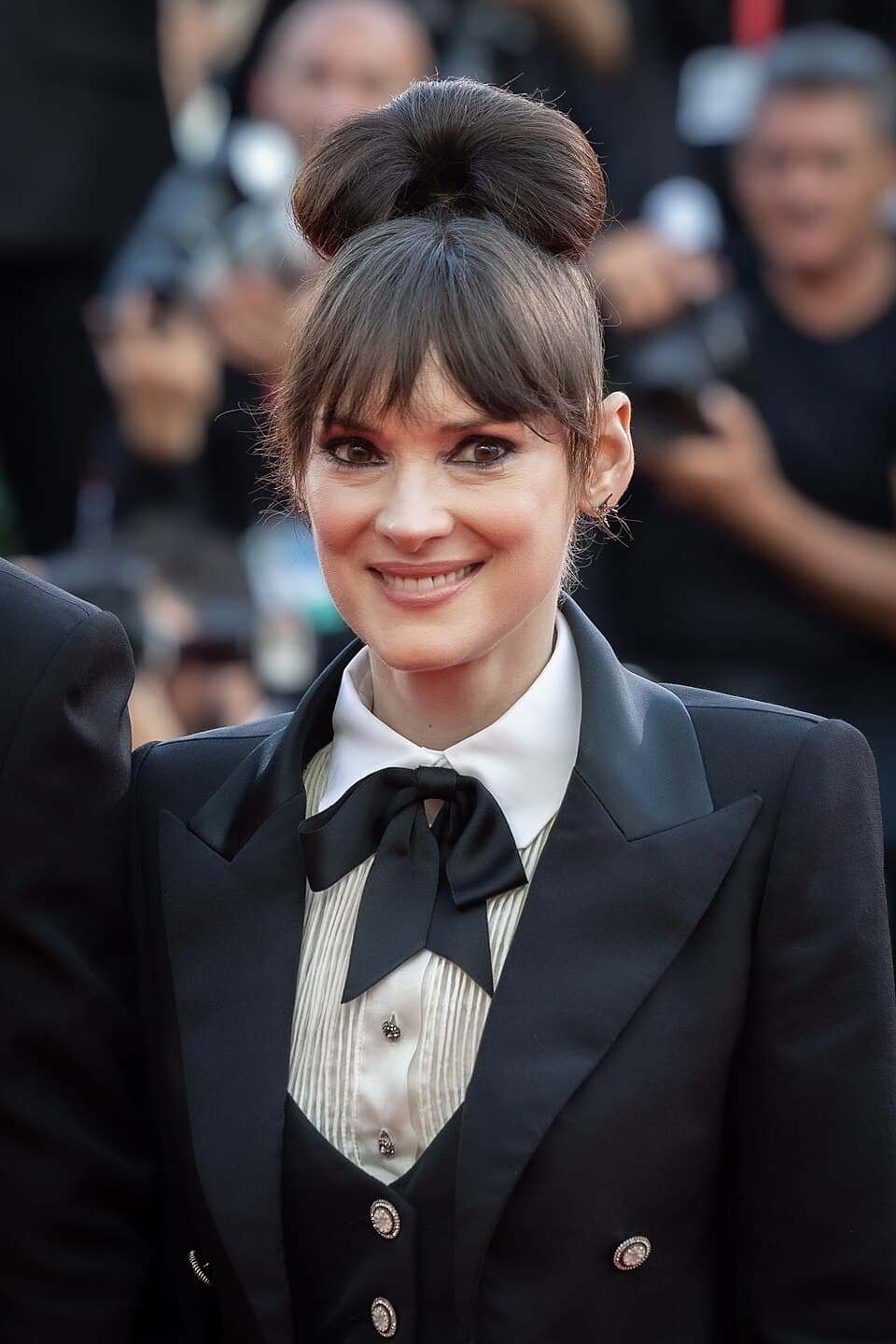
Winona Ryder, who has described her own eyes as brown, matching independent in-person reports.
Winona Ryder-63849 · Harald Krichel · CC BY-SA 4.0 · Wikimedia resize

What color are Winona Ryder's natural eyes?
Brown is the clearest source-backed answer, and the strongest evidence comes from Ryder herself. During an Interview conversation about acting choices, she acknowledged a habit of opening her big, brown eyes when she did not understand a director or scene. The wording is casual rather than clinical, yet it directly identifies her own broad natural category. It carries more weight than a fan label, automated biography or attempt to sample a compressed still from one of her films.
Independent observers agree. In 2024 the Los Angeles Times met Ryder in New York and described enormous brown eyes visible through a thick rim of eyeliner. Vogue’s restored 1999 cover profile discusses her big brown eyes in the context of Girl, Interrupted, including director James Mangold’s effort to let Ryder move beyond a familiar youthful screen image. These accounts span decades and very different settings while converging on brown. No equally strong reviewed evidence establishes black, hazel or green as the natural baseline.
Why does Ryder’s own statement matter?
First-person evidence is valuable when the language is explicit and the context is preserved. Ryder was not endorsing an eye-color product or repeating a trivia prompt. She was explaining how she had sometimes used her expressive gaze as a performance shortcut, and called the eyes brown in the course of that explanation. The statement does not tell us a precise subtype, pattern or pigment quantity, but it reliably answers the ordinary family-level question in the subject’s own words.
The acting context also prevents a common mistake. Ryder’s phrase is about expressive technique, not proof that every role preserves a neutral presentation. Directors, cinematographers and makeup teams can intensify, shadow or redirect attention toward the eyes. Vogue records Mangold discussing how much emotional development could register through Ryder’s gaze in Girl, Interrupted. That production commentary supports the importance of the eyes to her screen image, while her own wording supplies the color. Keeping those functions separate makes both pieces of evidence stronger.
How do independent profiles corroborate brown?
The Los Angeles Times account is a useful modern check because it places the writer and Ryder together during a long conversation connected to Beetlejuice Beetlejuice. The reporter notices brown even through a heavy black frame. That observation does not mean eyeliner reveals pigment more accurately; it means the broad label remains brown despite a styling choice that could make the irises look darker in photographs. The description agrees with Ryder’s earlier first-person language rather than depending on it.
Vogue’s 1999 profile adds a separate period and production context. Ryder watches Girl, Interrupted dailies at home, talks about how much her large eyes express, and is discussed by Mangold as an actor whose gaze can mark a character’s growth. Vogue’s surrounding prose uses big brown eyes as a recognizable visual shorthand. Editorial language can be colorful and is not a medical measurement, but agreement among the subject, an in-person contemporary reporter and an earlier major profile creates a notably strong evidence chain.
How makeup created Ryder’s signature gaze
Ryder’s visual identity often includes black liner, gray shadow, dark brows, deep lipstick and dark hair. Harper’s Bazaar’s beauty archive traces those combinations from Beetlejuice and Heathers through later red carpets, repeatedly noting punky, smudgy or heavily lined eyes. Its 2024 profile likewise meets Ryder with eyeliner framing her eyes. These choices increase contrast and reduce the amount of bare skin around the iris, which can make brown look deeper, glossier or nearly continuous with a large pupil in a small image.
Interview’s Heathers discussion shows that appearance was deliberately negotiable from the beginning. Ryder recalls going to a department-store makeup counter, then returning to persuade filmmakers who had not initially viewed her as right for the role. In a later Interview conversation she says Beetlejuice used little more than white powder on her face and retained her own hair and bangs. The degree of transformation varies by production, but neither account says the natural iris color changed. Styling explains the iconic frame, not a different baseline.
What about roles, colored contacts and heterochromia?
Beetlejuice, Heathers, Edward Scissorhands, Dracula and Stranger Things all place Ryder inside distinctive visual worlds. Interview’s retrospective accounts document powder, hair, makeup-counter styling and character-specific presentation, while Harper’s Bazaar catalogs changing liner, shadow, brows and hair. None of the reviewed sources identifies a colored lens used to replace her natural brown for those roles. A film may still alter apparent color through set light and grading, but that is not evidence of a physical lens.
The sources also do not report natural heterochromia. One eye may look warmer, lighter or more reflective when Ryder turns her face, when eyeliner is uneven, or when separate catchlights fall across the corneas. That variation should not be promoted into a medical or biological claim from images. The safe boundary is that Ryder herself and independent writers support brown. A future production participant could document a specific lens for a specific character, but that would remain a role fact rather than overturning her stated natural family.
How the Winona Ryder eye-color claim was checked
Verification starts with Ryder’s explicit first-person statement, then checks it against the Los Angeles Times encounter and Vogue’s restored 1999 profile. Interview’s Heathers and Beetlejuice discussions establish how makeup and character design changed her presentation, while Harper’s Bazaar supplies both an in-person contemporary profile and a documented archive of signature beauty looks. Those contextual sources are not counted as independent iris measurements; they explain why the same brown eyes can appear dramatically different across four decades of images.
The final answer is unusually secure at the broad level: Winona Ryder’s natural eyes are brown. The record does not justify a precise shade code or insist that every photograph should look identical. Black liner, gray shadow, pupil size, reflections, dark hair, low exposure and screen grading can make the irises look close to black or warmer brown. No reliable reviewed source establishes naturally black eyes, hazel eyes, habitual cosmetic contacts or heterochromia. The restraint preserves Ryder’s own statement rather than embellishing it.
Questions, answered carefully
Sources and what they support
Each source is attached to a specific claim. The portrait is licensed editorial imagery and is not treated as diagnostic evidence.
01 · Interview
Winona Ryder
First-person contextSource checked September 2, 2026
Ryder explicitly refers to her own big brown eyes.
Open source02 · Los Angeles Times
Winona Ryder on Returning With Beetlejuice Beetlejuice
Editorial profileSource checked September 2, 2026
An in-person account describes brown eyes through thick eyeliner.
Open source03 · Vogue
The Winona Nobody Knows
Editorial profileSource checked September 2, 2026
A home profile and production participant reinforce the brown-eye description.
Open source04 · Harper’s Bazaar
Winona Forever: Her Best Beauty Looks
Editorial profileSource checked September 2, 2026
Documents liner, gray shadow and role transformations.
Open source05 · Harper’s Bazaar
How Winona Ryder Made It to the Other Side
Editorial profileSource checked September 2, 2026
Documents eyeliner and Lydia’s visual continuity.
Open source06 · Interview
Winona Ryder on Heathers and Casting
First-person contextSource checked September 2, 2026
Ryder explains using makeup to change how casting directors saw her.
Open source07 · Interview
The Beloved: Winona Ryder
First-person contextSource checked September 2, 2026
Ryder describes the restrained original Beetlejuice makeup.
Open source