
Selena Gomez · Singer, actor and entrepreneur
Selena Gomez's Eyes: Dark Brown, Contacts Explained
Her natural irises are dark brown; two famous lighter-eyed appearances were documented colored-contact looks rather than a different everyday eye color.
- Evidence status
- Natural color + documented contact events
Last reviewed September 2, 2026
By Iris Analyzer Editorial Team
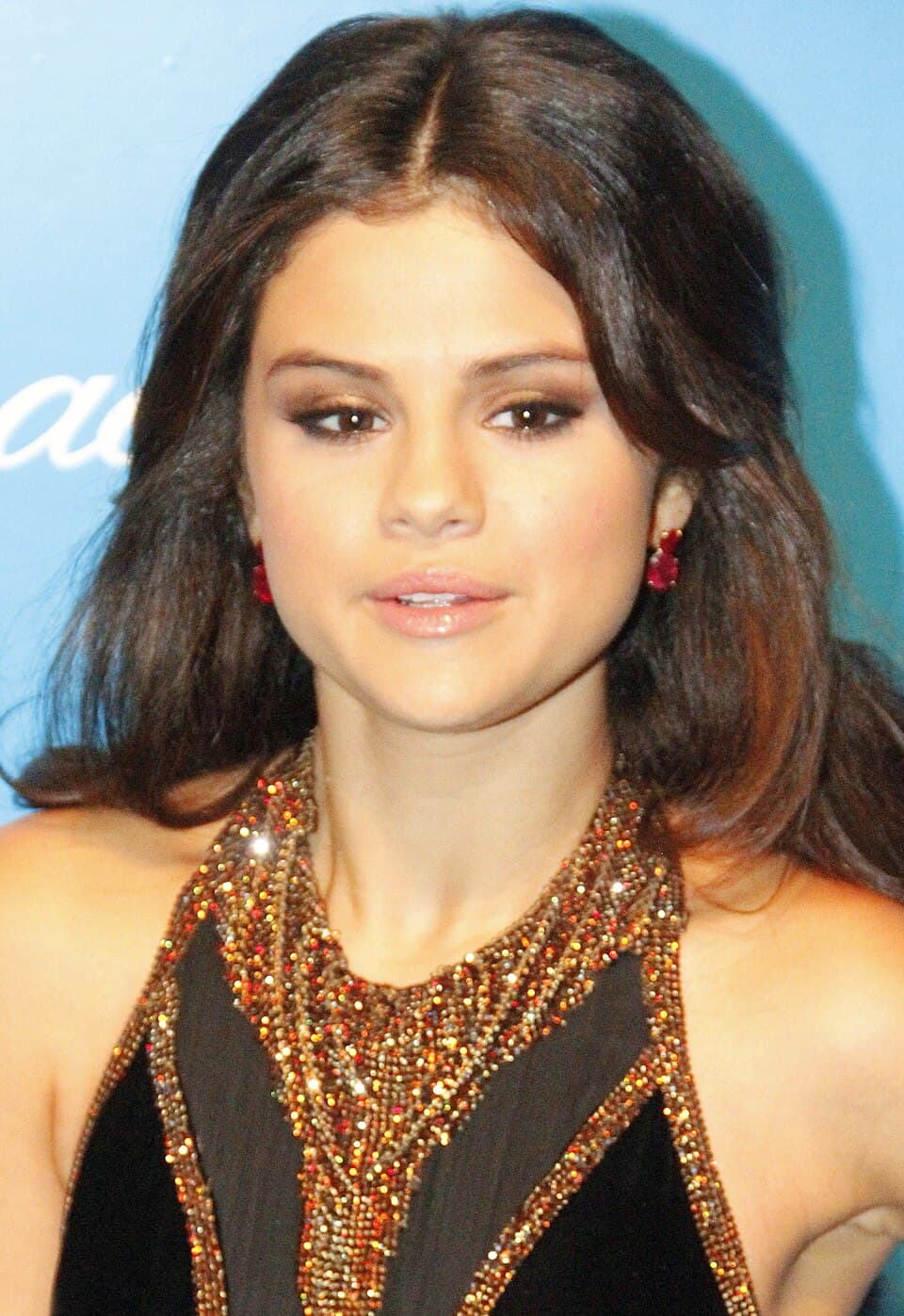
Selena Gomez, whose natural eyes Allure describes as intensely dark brown while documenting two colored-contact looks.
Selena Gomez UNICEF 2, 2012 (cropped) · Joella Marano · CC BY-SA 2.0 · Commons crop; Wikimedia resize
.jpg)
What color are Selena Gomez's natural eyes?
Intensely dark brown is the clearest source-backed answer. Allure’s report on Gomez’s 2015 American Music Awards appearance does something unusually useful: it distinguishes her normal eye color from the temporary look placed over it. The publication calls her natural color intensely dark brown, then identifies the visibly lighter appearance that evening as hazel-colored contacts. That explicit comparison is stronger evidence than choosing a favorite close-up and trying to label its pixels.
The wording supports a dark-brown answer without requiring an invented swatch or clinical measurement. Cleveland Clinic explains that familiar eye-color names are broad categories rather than a universal system of precisely divided shades. A warm catchlight can reveal reddish or golden detail within a brown iris, but that does not automatically turn the category into hazel or amber. For Gomez, the reviewed reporting supplies both the broad color and a reason some widely circulated images look different.
Which lighter-eyed contact looks are actually documented?
Two 2015 appearances are specifically documented. Allure identifies hazel contacts at the American Music Awards and says Gomez had recently worn blue-gray contacts at the Victoria’s Secret Fashion Show, where the look was inspired by Adriana Lima’s blue eyes. The same report presents the contact looks alongside her usual appearance. That provides a bounded explanation for particular photographs; it does not license the claim that every green, gray or honey-toned image of Gomez must involve a lens.
The article also says it was unclear whether Gomez or makeup artist Hung Vanngo proposed the hazel contacts. Preserving that uncertainty matters. It would be inaccurate to assign the choice to Vanngo merely because he worked on the beauty look. ELLE later used Gomez’s 2015 awards appearance as an example in its optometrist-informed guide to colored contacts, explaining that some lenses blend with a natural iris while more pigmented designs can mask dark eyes. Together, the reports establish the effect without inventing authorship.
How makeup changes the frame around dark brown eyes
Colored lenses are only one part of the visual story. In her Vogue Beauty Secrets routine, Gomez describes using color, sparkle, rose-toned liquid shadow, dark liner and mascara for a going-out look. Those products sit around the iris, yet they strongly influence how viewers perceive it. A sharp black wing raises local contrast, reflective shadow produces bright highlights near the eye, and mascara changes the apparent boundary created by lashes. None of those choices changes the underlying pigment.
Allure’s account of the Revival Tour offers an even more controlled example. Tour makeup artist Melissa Murdick built a soft metallic eye with copper shadow, deeper bronze around the crease and edges, black liquid liner and substantial false lashes. Warm copper and bronze can echo warm reflections in a brown iris, while stage lighting and distance determine how much detail survives. The result may look richer, lighter or more golden in a performance photograph even when no color-changing lens is documented for that image.
Why photographs alone do not settle the color
A peer-reviewed study proposing a photographic iris-color scale emphasizes standardized illumination, camera settings and processing. Celebrity photographs rarely satisfy those conditions. Event spotlights may be cool from one direction and warm from another; flash can place a bright catchlight over the iris; pupil size changes how much colored tissue remains visible; and the final file may be color graded, retouched, compressed and displayed on an uncalibrated screen. Sampling a pixel from that chain creates false precision.
Dark brown eyes are especially sensitive to exposure. Under dim light, the iris and pupil can merge into an almost black shape. Strong frontal light can reveal radial texture and warmer brown detail. Hazel contacts can then introduce still another layer by blending their printed pattern with the natural color underneath. A responsible profile therefore uses the written evidence to identify the baseline and photographs only to illustrate variation. Here, the baseline is dark brown, while two lighter event looks have their own documented explanation.
What colored-contact safety adds to the story
Colored contacts are not ordinary eye cosmetics. The U.S. Food and Drug Administration classifies decorative lenses as medical devices and says they require a prescription, proper fitting and professional guidance even when they do not correct vision. Poorly fitted or improperly handled lenses can cause abrasions, infection, reduced vision and more serious harm. That context belongs in a reference article because a striking celebrity look can encourage imitation without showing the clinical steps behind it.
The safety guidance should not be turned into speculation about Gomez’s own care, prescription or wearing habits. The reviewed entertainment sources document the appearance of contacts at two events; they do not provide her medical details, and this article does not infer them. The practical lesson applies to readers: changing visible eye color safely requires an eye-care professional and a legitimate prescription. A celebrity photograph is inspiration, not fitting advice, and a product that looks subtle on one dark-brown iris may behave differently on another.
How the Selena Gomez eye-color claim was checked
Verification began with the source that directly separates natural color from styling. Allure supplies intensely dark brown as the normal color and identifies the hazel and blue-gray lens appearances by event. ELLE confirms the American Music Awards example within a broader expert guide. Vogue preserves Gomez’s own explanation of her eye-makeup routine, while Allure’s tour report records Murdick’s copper, bronze, liner and lash construction. The FDA and photographic study supply medical and imaging boundaries rather than celebrity claims.
The conclusion is precise in scope. Gomez’s natural eyes are dark brown in the reviewed evidence. Hazel and blue-gray are documented contact looks at two named 2015 events, not competing descriptions of her everyday irises. The sources do not establish who originated the American Music Awards lens idea, and they do not prove contacts in every lighter-looking photograph. If a future first-person account adds detail, the profile can be updated; until then, dark brown with specifically documented temporary transformations is the defensible answer.
Questions, answered carefully
Sources and what they support
Each source is attached to a specific claim. The portrait is licensed editorial imagery and is not treated as diagnostic evidence.
01 · Allure
Selena Gomez Has a Genius Trick to Make Your Eyes Look Brighter
Editorial profileSource checked September 2, 2026
Allure identifies Gomez’s natural color as dark brown and documents specific hazel and blue-gray contact-lens appearances.
Open source02 · Cleveland Clinic
Eye Colors
Eye-health referenceSource checked September 2, 2026
Eye-color labels describe broad categories rather than universally agreed standardized shades. Hazel can combine visible brown, gold and green tones.
Open source03 · ELLE
What to Know About Colored Contacts
Eye-health referenceSource checked September 2, 2026
The guide uses Gomez’s 2015 appearance as a colored-contact example and explains that lenses can mask dark irises.
Open source04 · Vogue
Selena Gomez Does Her Going-Out Makeup Routine
First-person contextSource checked September 2, 2026
Gomez demonstrates shadow, liner and mascara choices that change contrast around the eyes.
Open source05 · Allure
How to Get Selena Gomez's Revival Tour Smoky Eye
First-person contextSource checked September 2, 2026
Her tour makeup artist explains the copper, bronze, liner and false-lash styling used around Gomez’s eyes.
Open source06 · Eye (Nature) via PubMed Central
A novel eye color classification scale for epidemiological studies
Scientific referencePublished December 13, 2013Source checked September 2, 2026
Reproducible photographic iris grading depends on standardized illumination, camera settings and processing.
Open source07 · U.S. Food and Drug Administration
Colored and Decorative Contact Lenses: A Prescription Is A Must
Eye-health referenceSource checked September 2, 2026
The FDA explains that decorative contact lenses are regulated medical devices and require a prescription.
Open source