
Madonna · Singer-songwriter, actor and producer
Madonna's Eyes: Light Blue or Blue-Green?
Light blue is the strongest direct description; blue-green is a credible refinement for a light iris whose apparent balance changes with makeup, reflections and illumination.
- Evidence status
- In-person profile + makeup professional
Last reviewed September 2, 2026
By Iris Analyzer Editorial Team
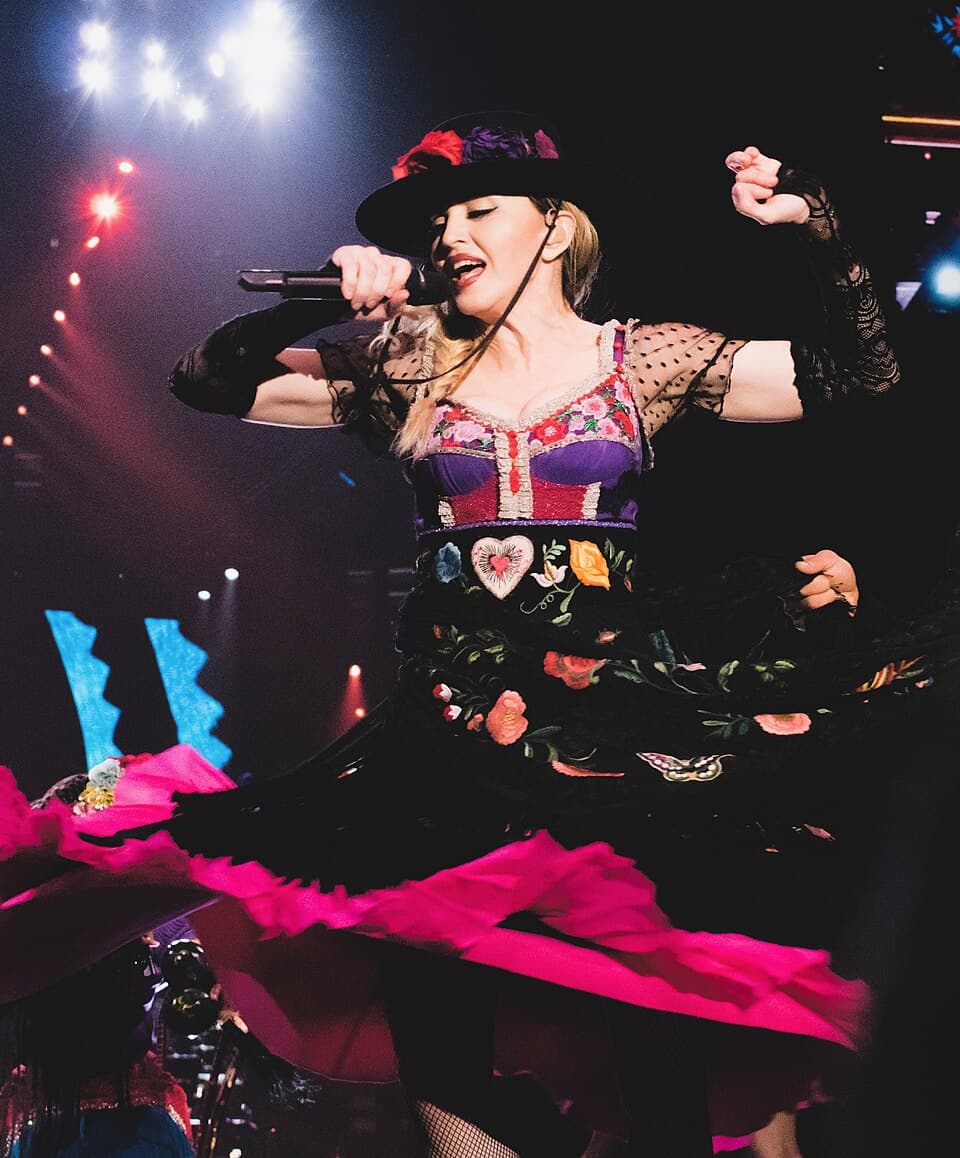
Madonna, whose eyes have been described directly as light clear blue and, in another major profile, blue-green.
Madonna - Rebel Heart Tour (cropped) · JD Urban · CC BY-SA 2.0 · Commons crop; Wikimedia resize
_(cropped).jpg)
What color are Madonna's eyes?
Light blue is the strongest concise answer. In a Guardian essay recounting two face-to-face meetings, the writer says Madonna’s eyes were a light, clear blue and emphasizes that photographs had not conveyed their true color. The same writer later refers to blue eyes again. Allure independently quotes Madonna’s touring makeup artist Gina Brooke explaining that aubergine-toned lashes enhance Madonna’s blue eyes. Both sources are close to the subject and agree on the broad family.
Vanity Fair’s major 1986 profile uses blue-green, a compatible refinement rather than evidence of unrelated colors. A light iris may show a greener cast under some conditions and a clearer blue under others. None of these descriptions is a clinical measurement, so the profile should not force a single digital swatch. The responsible hierarchy is light blue for the short answer, with blue-green retained as credible editorial language about how the same eyes can look in a different setting.
Why do blue and blue-green both appear?
Everyday color labels compress a patterned, reflective iris into familiar words. Low-pigment eyes can look cooler or warmer depending on the spectrum and direction of light, pupil size and the colors nearby. One observer may prioritize the overall blue field while another notices a greenish cast. The Guardian writer’s clear-blue wording and Vanity Fair’s blue-green description therefore occupy neighboring positions rather than establishing a biological change or an unresolved contradiction.
Source proximity helps organize those labels. The Guardian account is unusually explicit that the in-person color differed from the writer’s impression of photographs. Brooke’s professional comment independently confirms blue while discussing deliberate makeup contrast. Vanity Fair supplies historical nuance from another editorial era. Photographic iris-grading research uses standardized lighting and acquisition precisely because uncontrolled images do not reproduce color consistently. A source-checked article should report the convergence on blue and preserve the green refinement without pixel-sampling publicity photographs.
What do Madonna’s makeup artists establish?
Gina Brooke’s Allure interview is valuable because her decisions were made close to Madonna under the practical demands of touring. She says that lashes with a subtle aubergine base enhance Madonna’s blue eyes. Purple and aubergine sit in strong contrast with blue and can also draw attention to any greenish component. The wording is about emphasis, not alteration: the lashes frame an existing blue iris rather than supplying its color or demonstrating a cosmetic lens.
Debi Mazar offers a longer historical view. As Madonna’s friend and early makeup artist, she recalls using liquid liner to define the eyes. That direct styling context helps explain why the eye area changes so much across early performances, films and later tours even when the natural family remains stable. Black liner sharpens the border, false lashes change shadow and eye openness, and surrounding shadow changes simultaneous contrast. Neither professional account documents a different natural shade, routine colored contacts or heterochromia.
How does stage styling change the look?
Madonna’s stage makeup is designed to survive distance, movement and intense light. Allure’s account of her diamond eye shadow documents white shimmer, crushed diamonds and individual stones placed along the brow. Those reflective materials create large, bright highlights around the eyes and can make a light iris appear clearer, paler or more saturated. Aubergine lashes may push the image toward blue, while warmer spotlights or neighboring green tones can produce a blue-green impression.
Cameras add exposure, white balance, sensor response, retouching and final grading. Concert LED screens can cast colored reflections, and sunglasses or crystals may introduce further tint and glare. Cleveland Clinic explains that makeup, clothing and environmental light can bring out different apparent tones without changing actual eye color. Those effects account for many blue, gray-blue and greenish frames. They do not by themselves establish contacts, a new permanent shade or a medical change in Madonna’s irises.
Does Madonna wear colored contacts or have heterochromia?
The reviewed sources establish neither routine colored-contact use nor heterochromia. The Guardian writer describes the eyes together as light clear blue after meeting Madonna, Brooke refers normally to enhancing her blue eyes, and Vanity Fair uses blue-green collectively. None attributes the baseline color to lenses. That does not prove a cosmetic lens has never appeared in any costume or production; it means the evidence cannot support a broad claim that contacts create Madonna’s ordinary eye color.
A heterochromia claim would likewise require explicit first-person, clinical or strong editorial documentation of a stable left-right difference. One eye may look greener or darker in a photograph because it catches different light, sits partly in shadow, has a different catchlight or is less sharply focused. Unequal liner and lashes can increase that asymmetry. Those photographic conditions are not diagnostic. The reputable descriptions instead converge on one shared light color family, varying from blue toward blue-green.
How this eye-color claim was verified
Verification began with the closest explicit sources. The Guardian provides repeated first-hand observation and even notes the difference between seeing Madonna directly and seeing her in pictures. Allure quotes Gina Brooke, who designed touring makeup around blue eyes. Vanity Fair adds the credible blue-green refinement from a major contemporary profile. Debi Mazar and the diamond-shadow coverage then document how liner, lashes and reflective materials deliberately transform the surrounding presentation without asserting a new iris color.
The conclusion is deliberately bounded: light blue, sometimes blue-green, with normal variation across styling and photography. Cleveland Clinic supports the difference between tones being brought out and an actual adult color change, while iris-grading research explains why controlled image acquisition matters. No routine contact use, heterochromia, genetics, personality or health condition is inferred. The result preserves strong agreement where it exists and keeps the one meaningful shade difference visible rather than sensationalizing it.
Questions, answered carefully
Sources and what they support
Each source is attached to a specific claim. The portrait is licensed editorial imagery and is not treated as diagnostic evidence.
01 · The Guardian
Madonna Is My Guru
Editorial profileSource checked September 2, 2026
A writer who met Madonna describes her eyes as light clear blue.
Open source02 · Allure
Four Tips From Madonna’s Makeup Artist
First-person contextSource checked September 2, 2026
Touring makeup artist Gina Brooke calls Madonna’s eyes blue.
Open source03 · Vanity Fair
Madonna’s Superstardom and Pure Blonde Ambition
Editorial profileSource checked September 2, 2026
A contemporary profile describes Madonna’s eyes as blue-green.
Open source04 · Eye (Nature) via PubMed Central
A novel eye color classification scale for epidemiological studies
Scientific referencePublished December 13, 2013Source checked September 2, 2026
Reproducible photographic iris grading depends on standardized illumination, camera settings and processing.
Open source05 · Allure
Madonna’s First Makeup Artist Debi Mazar Spills
First-person contextSource checked September 2, 2026
Debi Mazar discusses early liquid-liner styling around Madonna’s eyes.
Open source06 · Allure
Madonna’s Diamond Eye Shadow
First-person contextSource checked September 2, 2026
Gina Brooke explains reflective white and crystal stage eye treatments.
Open source07 · Cleveland Clinic
Can Eye Color Change?
Eye-health referenceSource checked September 2, 2026
Apparent eye color can vary with lighting and surroundings, while a new persistent change warrants professional evaluation.
Open source