
Blue vs Gray Eyes: How to Tell Which You Have
Blue's rarest cousin hides in plain sight — settle it in daylight.
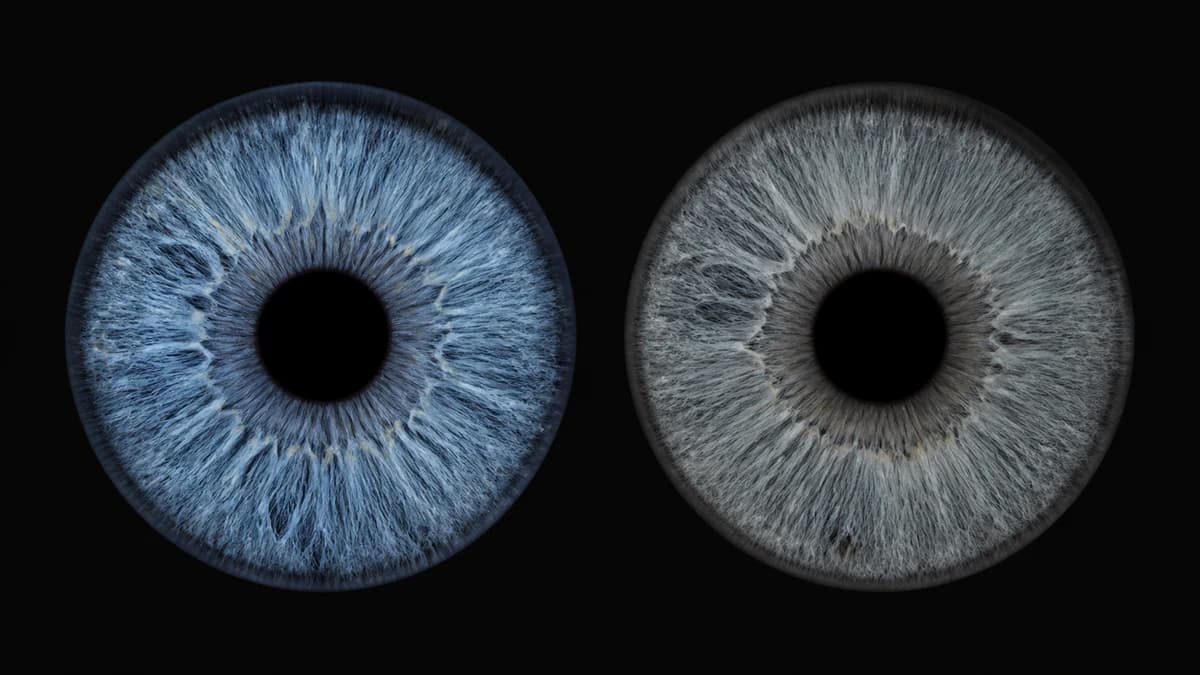
Same low pigment, different structure
Blue and gray (spelled "grey" in British English) are the two nearly-pigmentless eye colors, which is why they're so often confused. The difference is architecture, not melanin. In blue eyes, light scatters off fine stromal fibers in a way that favors short wavelengths — the same physics that makes the sky blue. Gray irises carry denser collagen; the coarser structure scatters all wavelengths more evenly, so no hue wins and the eye reads silver.
In short: blue is a color the eye produces, gray is a color the eye declines to produce.
The 60-second daylight test
Stand near a window in indirect daylight, wear something neutral, and look at a close-up photo of one eye:
- Hue test: is there a definite blue tint from pupil to rim? Blue. Silver, smoke, or steel with no clear hue? Gray
- Saturation test: blue keeps its color as light dims; gray drains toward colorless first
- Borrowing test: if your eyes take on your sweater's color or the sky's mood, that reflectivity is a gray tell
Why photos keep misleading you
Cameras are biased toward blue. Auto white balance cools indoor shots, sky reflections tint any pale iris, and compression smooths gray's subtle texture into an even blue-ish tone. If every photo of you shows slightly different "blue" eyes — sometimes steely, sometimes bright — the inconsistency itself suggests gray.
Gray's iris texture also differs: grays often show a smoother, mistier surface, where blue eyes display visible spokes and sunbursts.
Let saturation decide
A useful photo-based answer starts with a saturation estimate. A pixel-level analysis samples the visible iris: consistently low saturation across the disc points toward gray, a clear blue hue points toward blue, and the in-between comes back as an estimated blue-gray percentage mix. Use one evenly lit daylight photo for the most trustworthy comparison.
Stop guessing — measure it
Photo-based color percentages, rarity score, and a shareable Iris Card in 60 seconds. Private: your photo never leaves your device.
Analyze My Eye Color FreeFrequently asked questions
Are gray eyes rarer than blue eyes?
Considerably. Blue eyes sit around 8–10% of the world's population; truly gray eyes are roughly 1%, concentrated in Northern and Eastern Europe. Part of gray's rarity is statistical mislabeling — many grays go through life filed under blue.
Can eyes be blue-gray?
Yes — it's a spectrum, not a switch. Many low-pigment irises mix a blue hue with gray's dense structure and land in between. A color breakdown will show both families with percentages rather than forcing a single label.
Do gray eyes change color more than blue eyes?
They appear to. With almost no pigment and an even scatter, gray irises mirror their surroundings strongly — sky, clothing, makeup — reading blue-gray one day and green-gray the next. Blue eyes shift too, but their fixed hue anchors them.
Is gray an official eye color?
Yes. Older charts folded gray into blue, but modern classification treats it as its own category with its own structure — denser stromal collagen — and its own rarity, around 1% worldwide.