
Amber vs Hazel Eyes: What’s the Difference?
One is a solid gold; the other is a mix. Here’s the test.
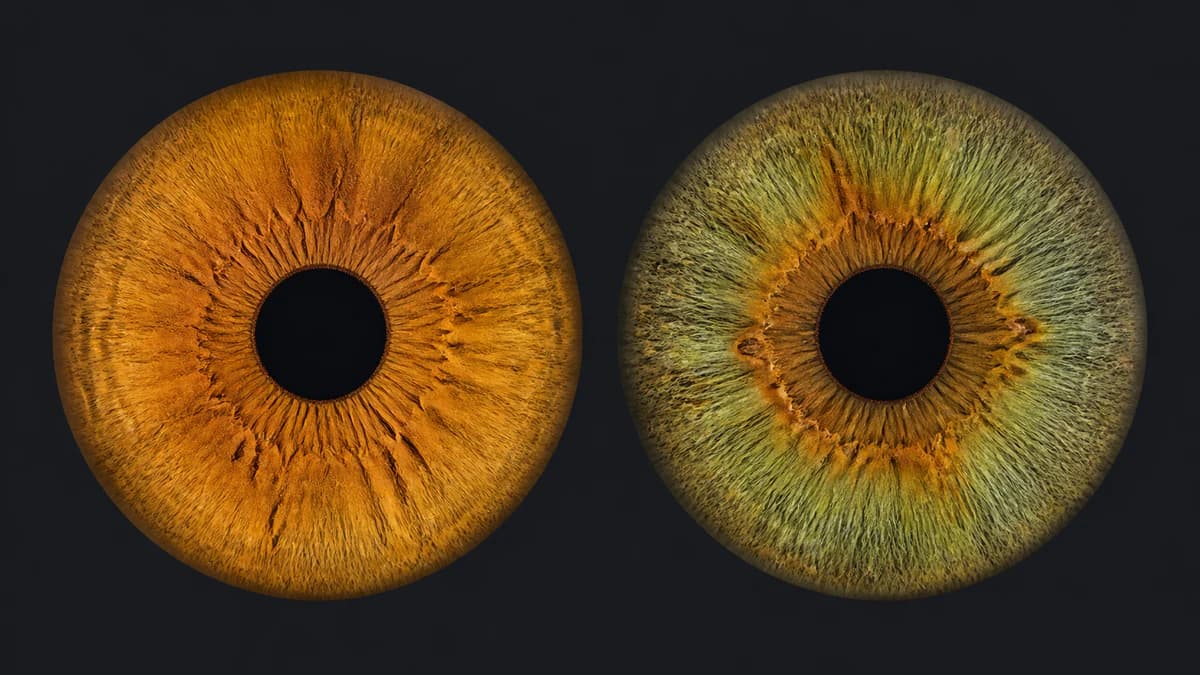
Amber vs hazel at a glance
True amber eyes are a single, uniform yellow-copper color across the entire iris — the "wolf eye" look. Hazel eyes contain two or more color families (green plus brown or amber), usually in distinct zones around the pupil.
The confusion happens because hazel cores are often amber-colored. But if the outer iris turns green or brown, it’s hazel, not amber.
- Overall pattern: amber is one even color; hazel is visibly mixed.
- Outer iris: amber stays gold or copper; hazel often turns green or brown toward the rim.
- Around the pupil: amber remains continuous; hazel commonly has a brown or gold central zone.
- In changing light: amber shifts in brightness; hazel can appear to shift between green and brown.
- Color analysis: amber is gold-dominant with little dark brown; hazel shows substantial green plus brown or amber.
The golden-brown trap
Most eyes called amber are actually light brown with strong golden undertones. The tell: a brown base visible beneath the gold, especially at the outer rim. True amber stays yellow-copper edge to edge, with little dark brown anywhere.
What a color breakdown shows
In a percentage analysis, true amber reads as a dominant amber/gold family with minimal dark brown. Hazel reads as a genuine mix — green, brown, and amber sharing the iris. Golden-brown reads brown-dominant with an amber secondary.
What produces the amber appearance
Human iris research points to the amount and type of melanin in the front of the iris, together with how light interacts with iris structure. It does not establish a separate "lipochrome" pigment as the cause of amber eyes. Amber is best described visually: warm golden-brown pigmentation that stays relatively uniform from pupil to rim.
That uniform distribution can look honey-gold in bright light and deeper brown indoors. The lighting changes the appearance, not the underlying pigment; hazel remains distinguished by clearly mixed green, brown, and gold zones.
Rarity: amber vs hazel worldwide
Hazel is the more common of the two at roughly 5% of people worldwide; true amber is generally estimated below 5%. The gap varies sharply by region — amber appears more often in parts of Asia and South America, while hazel is more common in people with European or Middle Eastern ancestry. In much of Northern Europe, both are unusual enough to get asked about.
Stop guessing — measure it
Photo-based color percentages, rarity score, and a shareable Iris Card in 60 seconds. Private: your photo never leaves your device.
Analyze My Eye Color FreeFrequently asked questions
Are amber eyes just light brown eyes?
No — though they’re often confused. Amber is a visual category for relatively uniform golden-copper pigmentation. Light brown eyes keep a more obvious brown base beneath any golden highlights, while hazel eyes show mixed color zones.
Which is rarer, amber or hazel?
True amber is rarer. Hazel occurs in roughly 5% of people; genuine uniform amber is well under that, with strong regional variation.
Can hazel eyes have an amber ring?
Very commonly — an amber ring around the pupil inside a green or brown outer zone is a classic hazel pattern (and a form of central heterochromia).
Why are amber eyes called wolf eyes?
Because the uniform golden-yellow iris is common in wolves, huskies, and birds of prey but rare in humans. The nickname refers to that same continuous honey color — no green zones, no brown patches, just one warm tone.
Can amber eyes fade or change over time?
After early childhood, iris pigmentation is normally stable; what changes is how the light makes it look. Strong daylight can make warm tones appear brighter, while dim indoor light can make amber read as light brown. A marked change in adulthood, especially in one eye, deserves an eye doctor’s assessment.